

5 Apr 2026
- 10 Comments
When a pharmaceutical company wants to bring a generic drug to market, they can't just prove the drug is chemically identical to the brand name version. They have to prove it works the same way inside the body. This is where bioequivalence testing comes in. The goal is to show that the generic version delivers the active ingredient to the site of action at the same rate and extent as the original. But how do you actually prove that? You either test it in a living organism (in vivo) or in a controlled lab setting (in vitro).
Choosing between these two isn't just about cost; it's about regulatory compliance and patient safety. If you pick the wrong method, you risk a rejected application or, worse, a product that doesn't work as expected once it hits the pharmacy shelves. Let's break down exactly when each method is used and why the choice matters.
The Fast Track: In Vitro Bioequivalence Testing
In vitro testing happens in a test tube or a specialized machine, completely outside a living body. In vitro bioequivalence testing is a laboratory-based assessment that uses physicochemical methods to predict how a drug will behave in the human body. It’s often the preferred route for companies because it's faster and significantly cheaper.
The most common tool here is dissolution testing. Instead of giving a pill to a person, scientists put it in a vessel that mimics stomach acid (pH 1.2 to 6.8). If 90% of the drug dissolves within 30 minutes, it's often a strong signal that it will be absorbed quickly in a real patient. For more complex products like inhalers, the FDA looks at things like droplet size distribution using laser diffraction or cascade impactors to see where the drug actually lands in the lungs.
Why go this route? Precision. In a lab, you can control every single variable. While human bodies vary wildly, a dissolution apparatus doesn't have "off days." In fact, the coefficient of variation (CV) for these tests is typically under 5%, whereas human studies often see swings of 10-20%.
| Method | What it Measures | Typical Use Case |
|---|---|---|
| Dissolution Testing | Rate of drug release in liquid | Immediate-release tablets |
| Cascade Impaction | Particle size and distribution | Metered-dose inhalers |
| Laser Diffraction | Droplet size accuracy | Nasal sprays |
| Permeation Testing | Rate of skin penetration | Topical creams/gels |
The Gold Standard: In Vivo Bioequivalence Testing
When a lab test isn't enough, you move to In vivo bioequivalence testing, which involves administering the drug to human subjects to measure its actual pharmacokinetic performance in the bloodstream. This is the most rigorous form of testing because it accounts for the "chaos" of human biology-things like gastric motility, enzyme activity, and pH shifts that a test tube simply can't replicate.
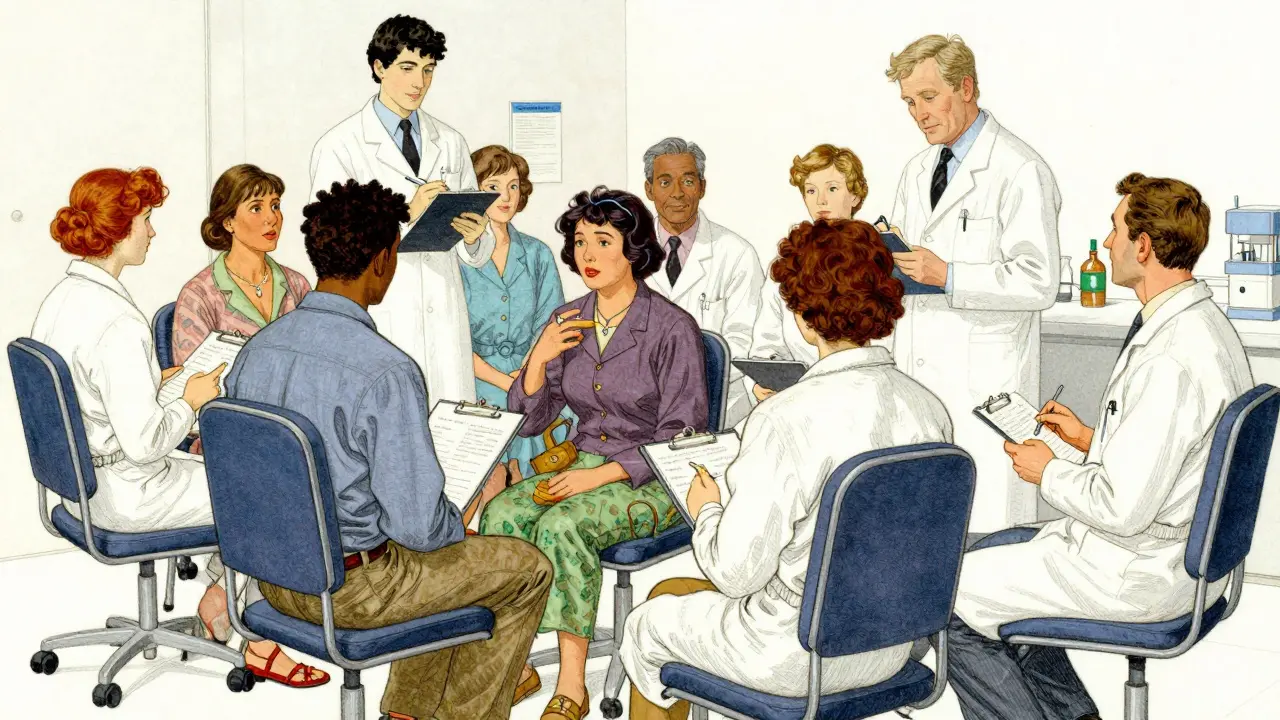
The standard setup is a 2×2 crossover design. This means a group of healthy volunteers (usually around 24 people) takes the generic drug, goes through a "washout period" to clear the drug from their system, and then takes the brand-name drug (or vice versa). Scientists then track two main numbers: Cmax (the peak concentration of the drug in the blood) and AUC (the total area under the curve, representing the total drug exposure over time).
For the FDA to give the green light, the 90% confidence interval for the ratio of these means must fall between 80.00% and 125.00%. If the numbers drift outside this window, the drugs aren't considered bioequivalent, and the generic may be rejected.
When to Use Which? The Decision Framework
You can't always just pick the cheaper lab test. The decision usually comes down to the Biopharmaceutics Classification System, or BCS, a framework that categorizes drugs based on their solubility and permeability.
Go with In Vitro (or a Biowaiver) when:
- The drug is BCS Class I: These drugs have high solubility and high permeability. They are absorbed so easily that if the dissolution is right, the in vivo result is almost guaranteed. In 2021, the FDA granted biowaivers for about 78% of Class I drugs.
- The action is local: If you're making a topical antifungal cream, the drug stays on the skin. Measuring how much enters the bloodstream isn't helpful, so in vitro permeation tests are more relevant.
- The delivery is too complex: For some inhalers, it's practically impossible to measure exactly where a drug lands in a living human lung without invasive surgery. Lab-based cascade impactors are the only realistic option.
- You have a strong IVIVC: An In Vitro-In Vivo Correlation (IVIVC) is a mathematical model that proves the lab results accurately predict the human results. If you have a "Level A" correlation (where the correlation coefficient r² is over 0.95), regulators are much more likely to accept lab data alone.
Stick to In Vivo when:
- The therapeutic index is narrow: This is a big one. For drugs like warfarin or levothyroxine, a tiny difference in dose can be the difference between a cure and a crisis. In these cases, the FDA tightens the rules, requiring a much stricter equivalence range of 90.00% to 111.11%.
- Food matters: Some drugs are absorbed differently whether you've eaten a burger or you're fasting. These require "fed-state" in vivo studies to ensure the drug works in all real-world scenarios.
- The drug has non-linear pharmacokinetics: If doubling the dose doesn't simply double the blood concentration, lab tests can't predict the outcome. You need human data.
Comparing the Practical Impact
From a business perspective, the difference is staggering. A senior formulation scientist at Teva Pharmaceuticals once noted that using an in vitro method for a BCS Class I product saved their company $1.2 million and 8 months of time compared to a human study. However, that speed comes with a trade-off: the prep work. Developing a lab method that the FDA actually accepts can take months of grueling validation.
On the flip side, relying too heavily on in vitro data for a complex product can backfire. A regulatory manager from Viatris shared a story where a topical product was approved via lab tests, but post-marketing reports showed it wasn't working as well as the brand name. They were forced to run an in vivo study after the fact, costing $850,000 and delaying their market expansion by nearly a year.
| Feature | In Vitro (Lab) | In Vivo (Human) |
|---|---|---|
| Average Cost | $50,000 - $150,000 | $500,000 - $1,000,000+ |
| Timeframe | 2 - 4 weeks | 3 - 6 months |
| Variability | Very Low (Low CV) | Higher (Biological variance) |
| Documentation | 50 - 100 pages | 300 - 500 pages |
| Regulatory Risk | Higher for complex drugs | Lowest (Gold Standard) |

The Future: Moving Toward a Hybrid Model
We are seeing a massive shift toward "model-informed" drug development. The FDA's 2020-2025 Strategic Plan is all about moving away from expensive human trials and toward smarter lab models. We're seeing the rise of Physiologically Based Pharmacokinetic modeling, or PBPK modeling, which uses computer simulations to predict how a drug moves through the body based on its chemical properties.
In late 2022, the FDA approved a generic budesonide nasal spray based entirely on in vitro data. This was a milestone because it proved that if the lab methods are "physiologically relevant" enough, we don't need to put humans at risk or spend millions on clinical trials. The industry is moving toward a world where in vitro testing is the first line of defense, and in vivo studies are reserved for high-risk, narrow-therapeutic-index drugs.
Can a company skip in vivo testing entirely?
Yes, this is called a biowaiver. This is most common for BCS Class I drugs (high solubility and permeability) or for certain complex products like nasal sprays if the company can provide extensive in vitro data and a validated IVIVC model that satisfies the FDA or EMA.
Why is the 80%-125% range used for in vivo studies?
This range is a statistical convention used by regulators to ensure that the difference between two products is not clinically meaningful. It accounts for the natural variability in how different people absorb the same drug.
What is the biggest risk of relying on in vitro data?
The biggest risk is a lack of clinical correlation. A drug might dissolve perfectly in a lab beaker but fail to absorb in a human due to gastrointestinal motility, pH changes in the gut, or interference from enzymes-factors that lab tests cannot fully replicate.
How long does an in vivo BE study typically take?
From protocol development and ethics committee approval to the actual crossover study and data analysis, the process usually takes between 4 and 8 months.
Do narrow therapeutic index (NTI) drugs have different rules?
Yes. Because NTI drugs are so sensitive, the FDA requires tighter bioequivalence limits (typically 90.00%-111.11%) and almost always mandates in vivo testing because the margin for error is too slim for lab tests alone.
Next Steps for Developers
If you're deciding which path to take for a new generic, start by mapping your drug's BCS class. If you're in Class I, focus your energy on developing a robust, multi-condition dissolution method to argue for a biowaiver. If you're dealing with an NTI drug, start your clinical site selection early, as the in vivo requirements will be non-negotiable.
For those working with complex generics (nasal or inhaled), don't rely on a single lab test. Combine cascade impactor data with physiologically relevant dissolution to build a stronger case for the regulators. When in doubt, a preliminary small-scale in vivo pilot study can save you from a massive, expensive failure during the formal submission phase.
Darius Prorok
April 5, 2026Everyone knows the 80-125% range is just a baseline. In reality, most companies aim for much tighter margins internally just to make sure they don't fail the FDA submission on the first try. It's basically common sense in the industry.
Toby Sirois
April 7, 2026This is so basic. Anyone who actually works in pharma knows that the BCS class is just the start. You're ignoring the whole nightmare of excipient variability which can wreck an in vitro test. It's honestly embarrassing that this is presented as a comprehensive guide.
Daniel Trezub
April 7, 2026Actually, I'd argue that PBPK modeling is overrated. It sounds great on paper, but it's mostly just fancy math to hide the fact that we still can't perfectly predict human biology. It's a nice trend, but don't bet your whole pipeline on a computer simulation.
Grace Lottering
April 7, 2026Biowaivers are just a way for big pharma to cut corners. They skip the human tests to save money and we're the ones who end up as the actual lab rats once these generics hit the market. Total scam.
Christopher Cooper
April 8, 2026It's fascinating how the balance between cost and safety is managed here. The shift toward physiologically relevant dissolution methods seems like a win-win for both the developers and the patients. I wonder how the EMA's current stance compares to the FDA's latest 2020-2025 plan regarding these hybrid models.
Sarabjeet Singh
April 8, 2026Great breakdown of the process. Keep pushing for these efficiencies!
GOPESH KUMAR
April 10, 2026The obsession with the 'Gold Standard' of in vivo testing is a relic of the past. We are moving toward a digital twin era where the biological chaos is simply a variable to be solved. To rely on 24 healthy volunteers to determine the efficacy of a drug for millions is not science, it's a statistical gamble. We must transcend these archaic methods if we want true innovation in medicine. The cost comparison table provided is a mere surface-level glance at a much deeper systemic inefficiency in how regulatory bodies operate. It's almost poetic that we spend millions to prove something that a well-validated IVIVC model could tell us in a week. The industry is stuck in a loop of fear-based compliance rather than logic-driven science. We need a complete overhaul of the BCS framework to incorporate real-time metabolic data. Until then, we're just rearranging deck chairs on the Titanic of pharmaceutical development. Absolute madness.
Jay Vernon
April 10, 2026Really helpful info! Thanks for sharing! 👍✨
Alexander Idle
April 10, 2026The drama of a rejected application is truly a corporate nightmare. Imagine the absolute chaos in the boardroom when that $850,000 mistake is revealed. It's just so tragic and wasteful!
Nathan Kreider
April 12, 2026I'm just glad there are people working hard to make these medicines more affordable for everyone. It sounds like a tough process, but the end result helps so many families.