
6 Mar 2026
- 14 Comments
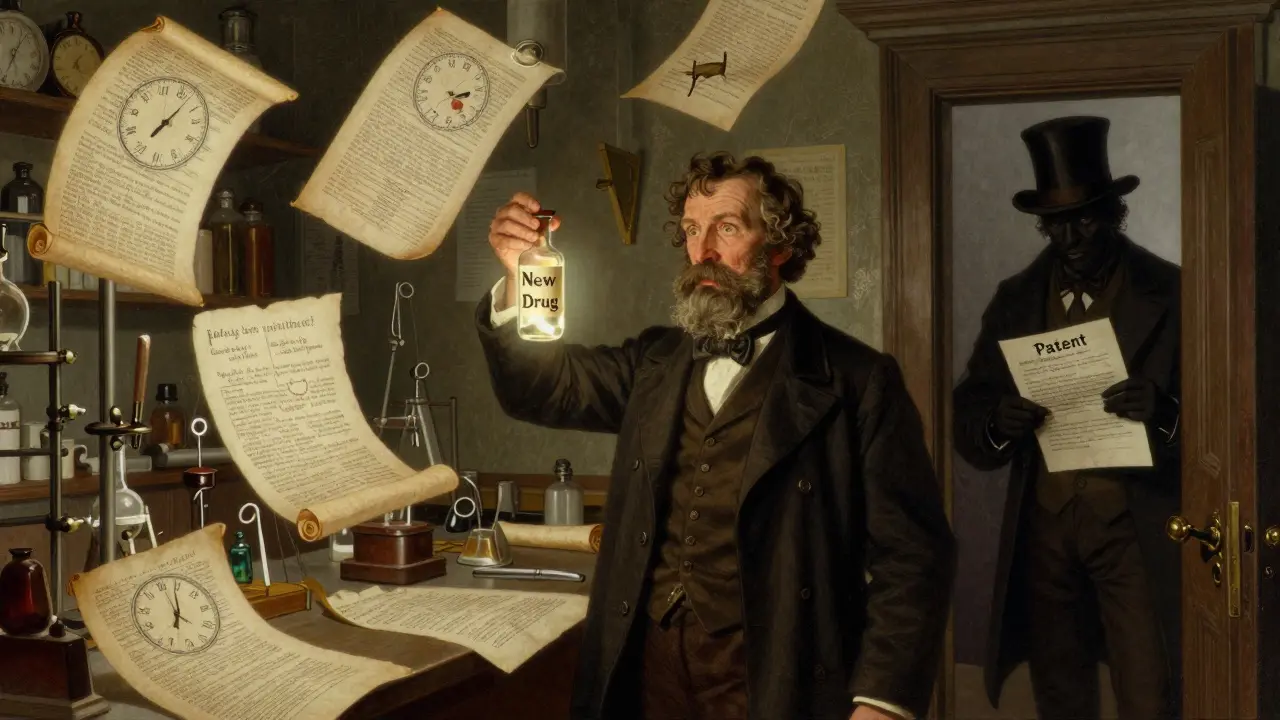
When a new drug hits the market, it doesn’t just appear out of nowhere. It’s the result of over a decade of research, clinical trials, and billions of dollars in investment. But without legal protection, companies wouldn’t risk that kind of spending. That’s where patent law comes in. It doesn’t just protect inventions-it keeps the entire system of medical innovation alive. And yet, the same system that protects drug makers also creates a path for cheaper, life-saving generics to enter the market. The balance between these two forces is what makes U.S. patent law in pharmaceuticals one of the most complex-and important-legal frameworks in modern healthcare.
How Patents Work in Drug Development
A pharmaceutical patent gives a company the exclusive right to make, sell, and distribute a new drug for 20 years from the date it was filed. Sounds simple, right? But here’s the catch: most of that 20-year clock ticks away during development, not sales. Clinical trials alone can take 8 to 12 years. By the time a drug gets FDA approval, a company might have only 8 to 10 years left to profit before generics can step in.
This is why the average effective market exclusivity for a new drug is just 12 to 14 years. During that window, companies charge premium prices. Why? Because bringing a new drug to market costs an estimated $2.6 billion on average, according to Tufts Center for the Study of Drug Development. That includes failed attempts, regulatory delays, and the cost of testing thousands of patients. Without patent protection, no company would fund this risky process.
But patents aren’t just about stopping competitors. They’re a signal. Investors look at patent filings to decide where to put their money. Researchers know which areas are being explored. Hospitals and insurers plan budgets based on when generics will arrive. The patent system doesn’t just protect profits-it structures the entire drug development pipeline.
The Hatch-Waxman Act: The Backbone of Generic Access
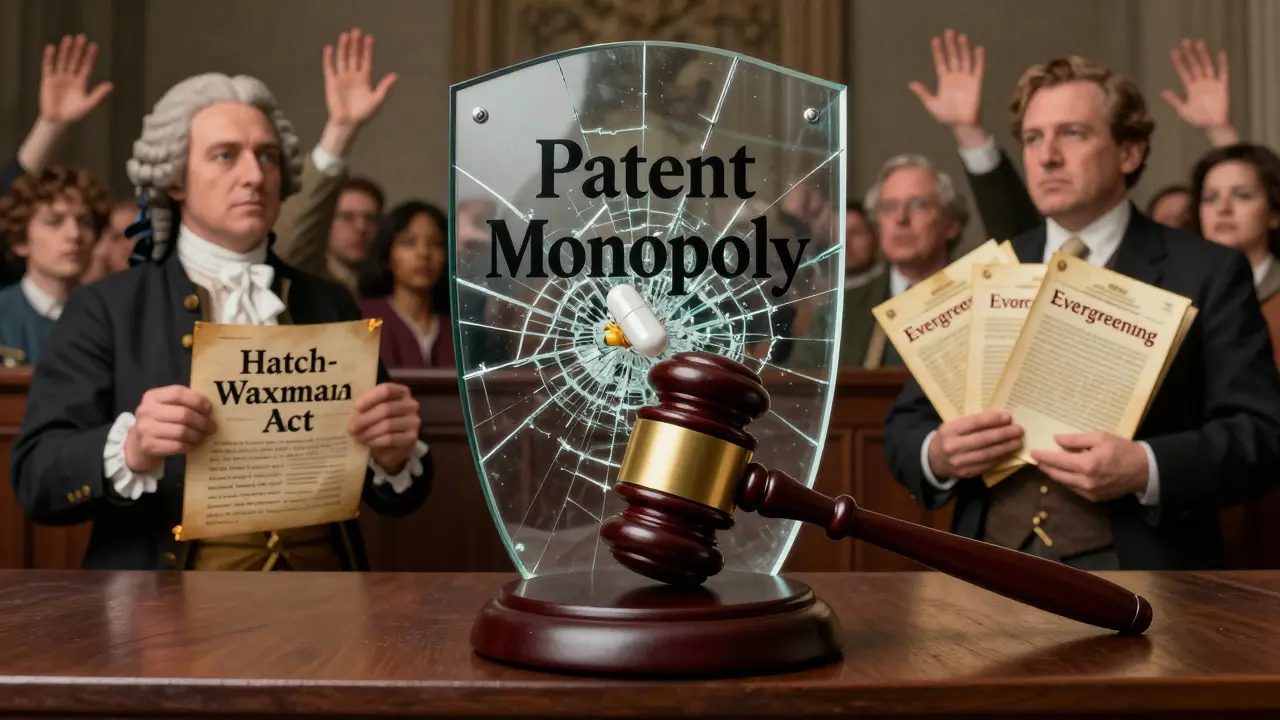
In 1984, Congress passed the Drug Price Competition and Patent Term Restoration Act-better known as the Hatch-Waxman Act. It was named after Senator Orrin Hatch and Representative Henry Waxman, who worked across party lines to fix a broken system. Before this law, generic manufacturers couldn’t even start testing a drug until the brand-name patent expired. That meant patients waited years longer for affordable options.
Hatch-Waxman changed everything. It created a legal shortcut for generics: instead of repeating all the clinical trials, generic companies could prove their drug was bioequivalent to the original. They only needed to show it worked the same way in the body. This cut development time from 10 years to under 2 years.
But here’s the trade-off: in exchange for this faster path, generic companies had to respect existing patents. The law required them to file what’s called a Paragraph IV certification if they believed a patent was invalid or wouldn’t be infringed. That triggered a legal countdown: if the brand company sued within 45 days, FDA approval of the generic was automatically delayed for 30 months-no matter whether the patent was actually valid.
This 30-month stay became one of the most powerful tools in pharmaceutical litigation. It gave brand companies a guaranteed buffer, even if their patent was weak. And it created a financial incentive: the first generic company to challenge a patent got 180 days of exclusivity, meaning no other generics could enter during that time. That’s why you’ll often see just one generic on the market right after a patent expires-because the first filer has a huge profit window.
How Generics Drive Down Prices
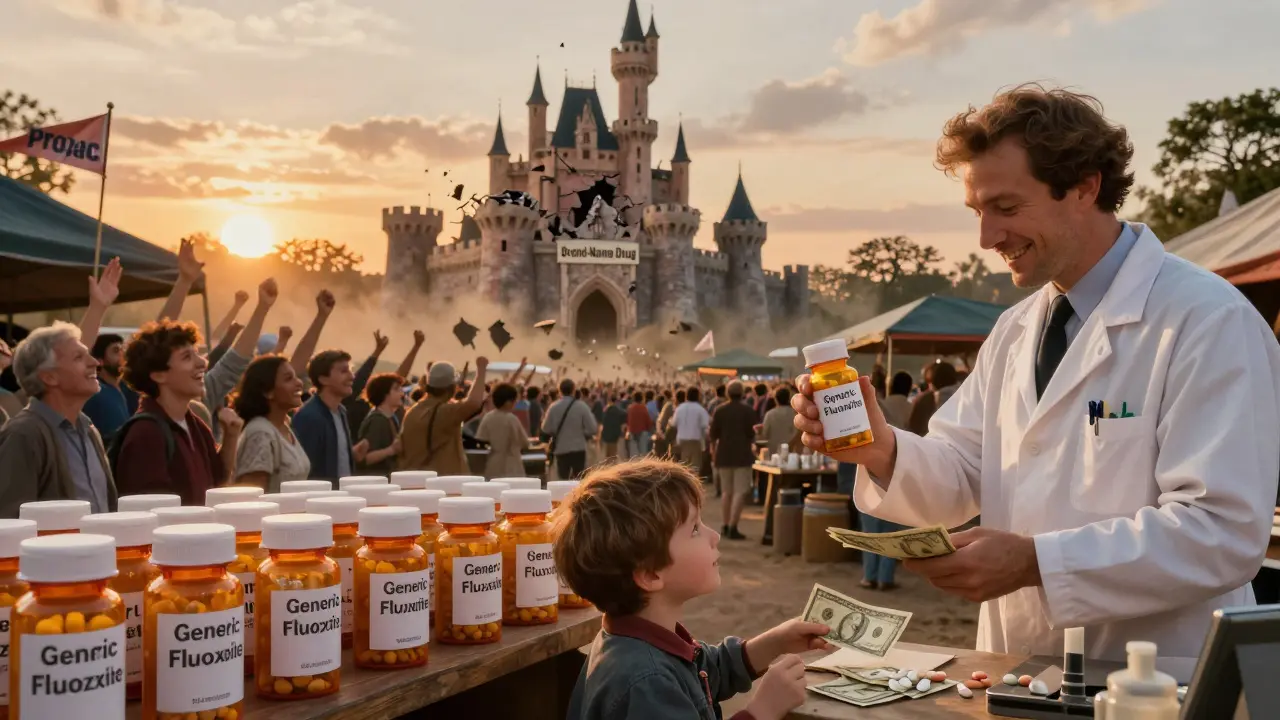
When generics finally arrive, prices don’t just drop-they collapse. The moment a generic enters, the brand loses about 80% of its market share. Within six months, prices fall by 70% on average. Add a second or third generic, and prices can tumble by 90%.
Take Prozac. When Eli Lilly’s patent expired in 2001, sales in the U.S. dropped by $2.4 billion in a single year. Today, fluoxetine-the generic version of Prozac-costs less than $10 for a 30-day supply. The brand version? You’d be lucky to find it on the shelf.
That’s not an outlier. The FDA says over 32,000 generic drugs are approved in the U.S. They make up 91% of all prescriptions but only 24% of total drug spending. In 2022 alone, generics saved the U.S. healthcare system $373 billion. That’s more than the GDP of many small countries.
Compare that to the ibuprofen market. When Boots’ Brufen patent expired in the 1980s, Advil and Motrin flooded in. Prices fell so hard that today, generic ibuprofen is cheaper than a bottle of water. No one remembers paying $50 for a bottle of painkillers. That’s the power of competition.
Patent Thickets and Evergreening: The Dark Side
But not all patent use is fair. Some companies use the system to delay competition-not to protect innovation, but to extend monopoly profits. This is called “evergreening.”
It works like this: after the main patent on a drug expires, companies file new patents on tiny changes-different dosages, new pill coatings, or altered release times. These aren’t new treatments. They’re minor tweaks. But under U.S. law, each one counts as a separate patent.
The most extreme example? Humira. The biologic drug for arthritis had 241 patents covering everything from manufacturing methods to packaging. That patent thicket delayed U.S. biosimilar entry until 2023-even though biosimilars were available in Europe since 2018. The result? Patients in the U.S. paid over $4,000 per month for a drug that now costs less than $500 in other countries.
The FDA’s Orange Book, which lists all patents linked to a drug, is supposed to bring transparency. But it’s often used as a weapon. Brand companies list every possible patent, even if it’s weak or irrelevant. Generic companies have to dig through dozens of claims just to know which ones to challenge.
That’s why the 2022 CREATES Act was passed. It made it illegal for brand companies to block generic manufacturers from getting samples of their own drug-something some companies had been doing to delay testing. Still, loopholes remain.
Pay-for-Delay and Legal Battles
Another tactic? Pay-for-delay settlements. This is when a brand company pays a generic manufacturer to stay out of the market. It sounds absurd-but it’s legal. The FTC estimates these deals cost consumers $3.5 billion a year.
One famous case involved AndroGel. The brand company paid a generic maker $90 million to delay its launch for over two years. The FTC sued. The courts eventually blocked the deal, but not before patients paid inflated prices for years.
Now, Congress is pushing the Preserve Access to Affordable Generics and Biosimilars Act to ban these deals outright. But the pharmaceutical lobby fights hard. Why? Because every month of delay is worth hundreds of millions in revenue.
Meanwhile, patent challenges are shifting. Generic companies now use inter partes review (IPR) at the Patent Trial and Appeal Board to knock out patents faster and cheaper than court litigation. But some brand companies are challenging the constitutionality of IPR itself. The Supreme Court has yet to rule-but if IPR is weakened, it could mean longer delays for generics.
The Future: Innovation vs. Access
Prescription drug spending hit $621 billion in 2022-22% of all U.S. healthcare costs. That’s unsustainable. But if we weaken patents too much, we risk killing innovation. No one will invest in cancer drugs, Alzheimer’s treatments, or rare disease therapies if they can’t recoup their costs.
The real challenge isn’t choosing between patents and generics. It’s fixing the system so that patents protect real innovation-not legal loopholes.
Some solutions are already working. The 180-day exclusivity for first filers still drives competition. The Paragraph IV process still forces patent challenges. The Orange Book still provides transparency, even if it’s messy.
What’s needed now is more accountability: stricter rules on evergreening, faster IPR reviews, and real penalties for pay-for-delay. The Hatch-Waxman Act was brilliant for its time. But the pharmaceutical landscape has changed. Biologics, biosimilars, AI-driven drug discovery-all of it demands a modern update.
For now, the system still works. Generics are cheaper. Innovation still happens. Patients still get life-saving drugs. But the balance is fragile. And if we don’t fix the cracks, the next generation of medicines might not come at all.
How long does a pharmaceutical patent last?
A pharmaceutical patent lasts 20 years from the date it was filed. However, because drug development takes 8-12 years before FDA approval, the actual time a company has to sell the drug without competition is usually only 8-12 years. Patent term restoration can add up to 5 years to make up for delays during FDA review.
What is the Hatch-Waxman Act?
The Hatch-Waxman Act of 1984 created a legal pathway for generic drugs to enter the market without repeating expensive clinical trials. It allows generics to file an Abbreviated New Drug Application (ANDA) by proving bioequivalence. In return, brand companies get patent term extensions and a 30-month stay on generic approval if their patent is challenged.
Why do generic drugs cost so much less?
Generic drugs cost 80-85% less because they don’t need to repeat costly clinical trials. They only need to prove they work the same way as the brand-name drug. The savings come from avoiding R&D costs, marketing expenses, and patent licensing fees. Competition among multiple generic makers drives prices even lower.
What is a Paragraph IV certification?
A Paragraph IV certification is a legal statement filed by a generic drug manufacturer that says a brand-name drug’s patent is either invalid or won’t be infringed. This triggers a 45-day window for the brand company to sue. If they do, FDA approval of the generic is automatically delayed for 30 months-regardless of whether the patent is actually valid.
Do patents stifle innovation in generics?
No-patents actually drive innovation in generics. The threat of patent litigation pushes generic companies to develop better formulations, delivery systems, and manufacturing techniques. The 180-day exclusivity for first filers incentivizes companies to challenge weak patents. Without patents, there would be no financial reason for generics to enter the market at all.
What’s the difference between a generic and a biosimilar?
Generics are exact copies of small-molecule drugs made from chemical compounds. Biosimilars are highly similar-but not identical-to complex biological drugs made from living cells. Because biologics are harder to replicate, biosimilars require more testing and face more patent barriers. The Biologics Price Competition and Innovation Act (BPCIA) governs biosimilars, but litigation over patent disclosure (the "patent dance") has slowed their adoption in the U.S.
Weston Potgieter
March 7, 2026Patents are just corporate handouts with a fancy name. 20 years? More like 15 years of monopoly after you already got your R&D cash back. And don't get me started on Humira - $4000 a month for a drug that's basically a modified antibody. This isn't innovation it's rent-seeking.
Vikas Verma
March 9, 2026The Hatch-Waxman Act remains a masterstroke of policy engineering. By harmonizing innovation incentives with market access, it created a sustainable ecosystem. Generic manufacturers now leverage bioequivalence protocols to reduce time-to-market by over 80%. This is not just economics - it's public health architecture.
Sean Callahan
March 10, 2026I just read this whole thing and honestly? I'm confused. Like... so patents are good? But also bad? And generics are cheap but also not always available? And companies pay each other to not sell stuff? Wait what? Someone explain this like I'm five. I just need my insulin to not cost my kidney.
phyllis bourassa
March 11, 2026You know what's really sad? The fact that we're still debating this in 2025. We have AI that can design drugs in days. We have CRISPR. We have global supply chains. And yet we're stuck in a 1984 legal framework where a company can patent the color of a pill and call it innovation. This isn't capitalism. It's feudalism with lawyers.
Ferdinand Aton
March 11, 2026Actually, patents don't protect innovation at all. They protect lawyers. Look at the stats - most new drugs are just minor tweaks. The real breakthroughs? Those come from academia, funded by NIH. The pharma companies just buy them up and jack up the price. Patents are just a tax on sick people.
William Minks
March 12, 2026This is wild 😍 I had no idea generics saved $373B last year! That's like... more than the entire budget of NASA 🚀 And the fact that ibuprofen costs less than water? Mind blown. We need to celebrate this system more. It's one of the few things in healthcare that actually works.
Jeff Mirisola
March 13, 2026I appreciate the nuance here. The system is flawed but functional. We don't need to tear it down - we need to tune it. Fix the Paragraph IV abuse. Close the 30-month loophole. Make the Orange Book transparent. We can have both innovation and access. It's not an either/or. It's a balancing act - and we're not even trying.
Susan Purney Mark
March 13, 2026As someone who's been on 3 different life-saving meds over the last decade, I just want to say thank you to the generic manufacturers. 💖 I remember when my asthma inhaler cost $400. Now it's $12. That's not just savings - that's dignity. Keep fighting for access.
Ian Kiplagat
March 14, 2026Interesting. The UK system handles this differently. We have price negotiations and bulk purchasing. Patents exist but don't dictate pricing. Generics enter faster. Costs are lower. Maybe we should look beyond the US model.
Amina Aminkhuslen
March 15, 2026Evergreening is a scam. A slick, well-funded, lawyer-backed scam. They patent the shape of the pill. The flavor. The packaging. The damn blinking light on the bottle. It's not innovation. It's legal graffiti. And we're all paying for it.
Tim Hnatko
March 17, 2026I work in a rural clinic. We see patients choosing between insulin and groceries. The generics saved our community. But I also know researchers who've spent 15 years on a cancer drug only to see it priced out of reach. We need a system where profit doesn't override purpose.
Aaron Pace
March 18, 2026I just saw a TikTok that said 'patents are theft' and I was like... wait is that true? Then I read this. Now I'm mad. Like, really mad. Why does my blood pressure med cost $500? I'm not rich. I'm not even middle class. I'm just trying to live.
Roland Silber
March 18, 2026The real issue isn't patents - it's the lack of public investment in early-stage R&D. Pharma gets all the credit and all the profit. But the foundational science? That's taxpayer-funded. NIH. Universities. Public labs. We're outsourcing innovation to private entities and then paying them 10x to deliver it back to us. That's backwards.
Patrick Jackson
March 19, 2026Think about this: if we removed patents entirely tomorrow, would innovation collapse? Or would it just shift? Would we see more open-source drug discovery? More collaborative research? More public labs working with global partners? Maybe the problem isn't the lack of patents... but the over-reliance on a single, broken model. Maybe we need a new paradigm. One that doesn't treat medicine like a luxury good.