
14 Jan 2026
- 11 Comments
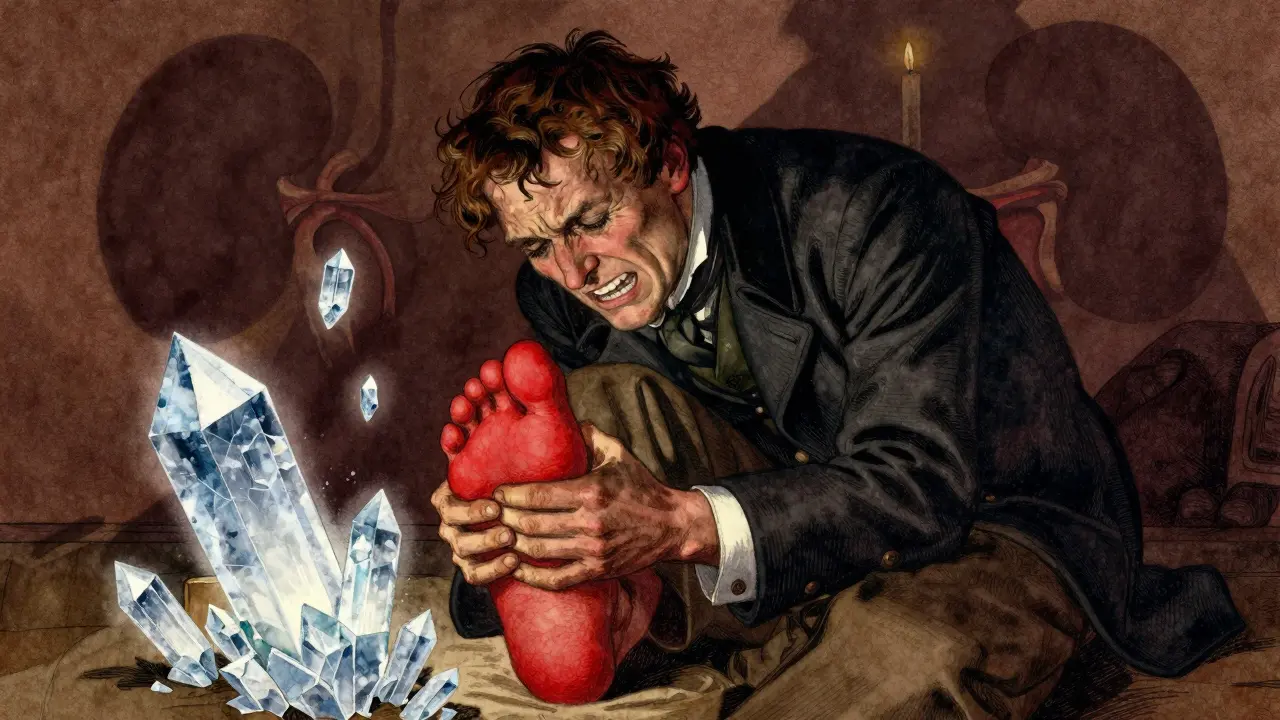
When your big toe suddenly swells up, turns bright red, and feels like it’s on fire-even the lightest touch sending sharp pain through your body-you’re not just having a bad day. You’re having a gout attack. It doesn’t come out of nowhere. It’s the result of something building up quietly in your blood for months or even years: uric acid.
What Exactly Is Uric Acid Doing in Your Body?
Uric acid is a waste product your body makes when it breaks down purines-natural substances found in your cells and in certain foods. Most people’s kidneys flush it out through urine without issue. But when too much builds up, it forms sharp, needle-like crystals in your joints. That’s when things go wrong. The magic number is 6.8 mg/dL. That’s the point at which uric acid starts to crystallize in your blood, especially in cooler areas like your toes, knees, and fingers. Humans are one of the few mammals that can’t break down uric acid completely. We lost the enzyme uricase thousands of years ago during evolution, which is why gout is so common in people but rare in dogs or cats. About 90% of gout cases happen because your kidneys aren’t getting rid of uric acid fast enough. The other 10%? Your body’s making too much of it. Genetics play a huge role here-up to 60% of your uric acid levels are determined by your genes, especially variations in SLC2A9, SLC22A12, and ABCG2. These genes control how your kidneys handle uric acid. If they’re not working right, uric acid piles up.What Triggers a Gout Attack?
You might think eating a steak or drinking a beer caused your flare-up. But that’s not quite right. Those things didn’t cause the crystals-they just stirred them up. Gout attacks often happen after a sudden change in uric acid levels. Even lowering uric acid too fast can trigger a flare. That’s why starting a new medication like allopurinol can sometimes make things worse before they get better. Here are the most common triggers:- Beer and liquor: Beer is the worst offender. Each 12-ounce serving increases your risk by 49%. Spirits raise it by 15%. Wine? Not much effect. The purines in beer, combined with alcohol’s effect on kidney function, make it a double hit.
- Red meat and organ meats: Liver, kidney, and sweetbreads contain 300-500 mg of purines per 3-ounce serving. A single steak can push your uric acid sky-high.
- Sugary drinks: Soda, sports drinks, and fruit juices sweetened with fructose spike uric acid production by 20-30%. Fructose is metabolized in the liver and uses up ATP, which breaks down into purines.
- Dehydration: If you’re not drinking enough water, your urine output drops below 1.5 liters a day. That means less uric acid gets flushed out.
- Joint injury or surgery: Even a minor bump or sprain can cause crystals to break loose from old deposits called tophi.
- Starting or stopping uric acid-lowering drugs: Any big change in blood uric acid-up or down-can trigger inflammation.
How Your Body Turns Uric Acid Into Pain
It’s not the crystals themselves that hurt. It’s your immune system’s reaction to them. When uric acid crystals form in your joint, your body’s immune cells-called macrophages-see them as invaders. They activate something called the NLRP3 inflammasome. That’s a molecular alarm system that releases interleukin-1β, a powerful chemical that brings in white blood cells, causes swelling, heat, and extreme pain. That’s why gout flares feel so intense. It’s not just arthritis-it’s an all-out inflammatory response. And unlike other types of arthritis, gout attacks often come on suddenly, usually overnight. By morning, your toe might be too painful to put on a sock.What to Do During a Gout Attack
When a flare hits, your goal is to stop the inflammation fast. The American College of Rheumatology recommends three main options:- NSAIDs: Indomethacin (50 mg three times a day) or naproxen are first-line. They reduce swelling and pain within hours. But they’re not safe if you have kidney disease, heart failure, or stomach ulcers.
- Colchicine: Taken at 0.6 mg every hour until symptoms improve (up to 3 doses) or side effects start (like diarrhea). For ongoing use, it’s often 0.6 mg once or twice daily. It works by blocking the immune response to crystals.
- Corticosteroids: If you can’t take NSAIDs or colchicine, a short course of prednisone (30-40 mg daily for 5 days) works just as well. Some doctors inject steroids directly into the joint for fast relief.

Long-Term Strategy: Lowering Uric Acid for Good
Medications for flares don’t fix the root problem. To prevent future attacks, you need to lower your uric acid levels for life. The target? Below 6 mg/dL. For people with tophi (visible lumps of crystals under the skin), aim for 5 mg/dL or lower. At that level, crystals start to dissolve. Over time, tophi shrink and disappear. Here’s what works:- Allopurinol: First-choice drug. Starts at 100 mg daily. Your doctor will slowly increase it by 100 mg every few weeks until your uric acid is under target. Most people need 300-600 mg daily. Some need up to 800 mg. It blocks uric acid production.
- Febuxostat: Used if allopurinol causes side effects or doesn’t work. Works the same way but is processed by the liver, not the kidneys. Good option if you have kidney issues.
- Probenecid: A uricosuric drug that helps your kidneys flush out more uric acid. Only works if your kidneys are healthy (GFR above 50 mL/min). Not for people with kidney stones.
The Secret Weapon: Preventing Flares When Starting Treatment
Here’s the big mistake most people make: They start allopurinol, feel fine, and stop taking it when a flare happens. That’s exactly when you should keep going. The first 6 months on uric acid-lowering drugs are the riskiest. Up to 40% of people have flares during this time. But there’s a simple fix: take low-dose colchicine (0.6 mg once or twice daily) during this period. Studies show this cuts flare frequency by 50-75%. It’s not a cure-it’s insurance. You’re not treating the flare; you’re preventing it while your body adjusts to lower uric acid levels.Diet and Lifestyle: What Actually Helps
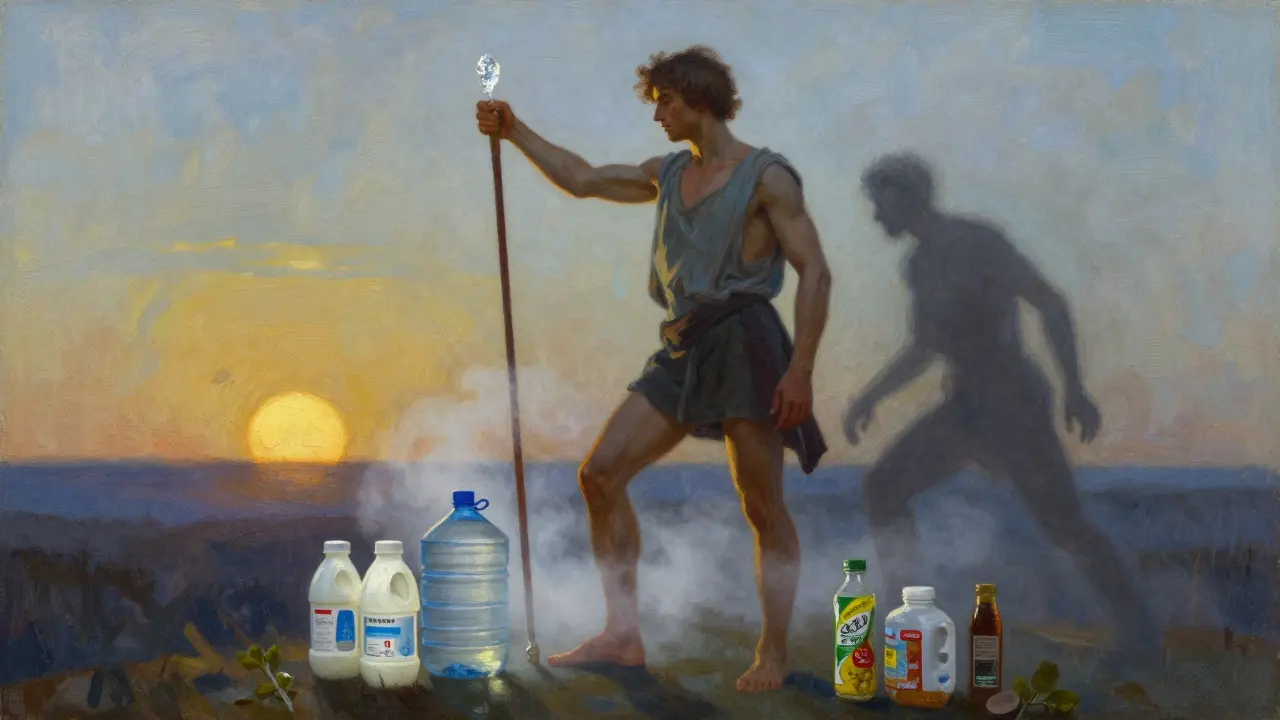
Diet alone won’t cure gout. But it can make a huge difference in how often you flare.- Drink more water: Aim for 2-3 liters daily. More urine = more uric acid flushed out.
- Choose low-fat dairy: Milk, yogurt, and cheese reduce gout risk by 43% per serving. The proteins in dairy help your kidneys excrete uric acid.
- Limit red meat and shellfish: Swap steak for chicken or tofu. Skip lobster, scallops, and sardines.
- Avoid fructose: No soda, no sweetened juices. Even “natural” fruit juices can trigger flares.
- Limit alcohol: If you drink, stick to wine. Keep beer under one 12-ounce serving per day.
Monitoring and Adherence: The Hidden Key
Many people think, “I haven’t had a flare in 6 months-I’m cured.” That’s dangerous. Uric acid levels bounce back within 2-4 weeks if you stop your medication. That’s why regular blood tests are critical. Get your uric acid checked every 2-5 weeks while adjusting your dose. Once you’re stable, check it every 6 months. Also, don’t ignore side effects. Allopurinol can cause a rare but serious allergic reaction called hypersensitivity syndrome. If you get a rash, fever, or swollen lymph nodes, stop it and call your doctor. Colchicine can cause diarrhea. If it’s mild, keep taking it. If it’s severe, talk to your doctor about lowering the dose.What’s Next? New Treatments on the Horizon
Researchers are working on drugs that target the NLRP3 inflammasome directly-the same pathway that triggers gout pain. Early trials with drugs like dapansutrile show they can cut flare duration by 40% compared to placebo. Another promising area? Gut health. Early studies suggest certain probiotics might help break down purines in the intestines, lowering uric acid by 10-15%. It’s not a replacement for medication yet, but it could become part of a full plan. The biggest breakthrough? We now know that if you keep uric acid below 5 mg/dL for a year, 70% of people with tophi see them completely disappear. That’s not just symptom control-it’s disease reversal.What to Do Right Now
If you’ve had a gout attack:- Don’t wait. See your doctor to confirm the diagnosis.
- Get a blood test for serum uric acid.
- Ask about starting low-dose colchicine if you’re beginning uric acid-lowering therapy.
- Set up a plan for long-term medication and monitoring.
- Start drinking more water, cutting out sugary drinks, and swapping red meat for plant-based proteins.
Can gout be cured completely?
Gout can’t be cured in the traditional sense, but it can be fully controlled. With consistent uric acid-lowering therapy and lifestyle changes, most people stop having flares entirely. Tophi can shrink and disappear. The key is keeping your serum uric acid below 6 mg/dL-or even 5 mg/dL-for years. Stopping medication means the crystals come back.
Why does gout hurt so much?
The pain comes from your immune system’s overreaction. Uric acid crystals trigger the NLRP3 inflammasome in immune cells, which releases interleukin-1β, a powerful inflammatory signal. This causes swelling, heat, and extreme sensitivity in the joint. It’s not the crystals themselves-it’s your body’s defense system going into overdrive.
Is it safe to take NSAIDs for gout long-term?
No. NSAIDs like indomethacin or naproxen are meant for short-term flare relief, not daily use. Long-term use can damage your kidneys, raise blood pressure, or cause stomach bleeding. For long-term control, focus on uric acid-lowering drugs like allopurinol, not daily painkillers.
Can I drink alcohol if I have gout?
Beer is the worst-each daily 12-ounce serving increases your risk by 49%. Spirits also raise risk, though less. Wine has little to no effect. If you drink, limit beer to one serving per day and avoid binge drinking. The safest approach is to cut alcohol entirely, especially if you’ve had multiple attacks.
What’s the best way to prevent gout flares?
Three things: take your uric acid-lowering medication daily, drink 2-3 liters of water every day, and avoid sugary drinks and beer. Add low-fat dairy to your diet. Keep your uric acid below 6 mg/dL. If you’ve had tophi, aim for 5 mg/dL. Consistency beats perfection.
ellen adamina
January 15, 2026Been dealing with this for years and this is the first time someone explained why my toe feels like it’s being stabbed by tiny glass needles
Jaspreet Kaur Chana
January 15, 2026As someone from India where we love our biryani and beer on weekends, I used to think gout was just a rich person’s problem until my uncle lost his job because he couldn’t walk after a flare. Turns out our traditional lentils and dried fish are packed with purines too. I started swapping out the lager for buttermilk and honestly? My mornings don’t feel like a war zone anymore. Also, water. Drink more water. Like, a whole damn lake of it. My mom always said water flushes out toxins but I thought she was just being old-fashioned. Turns out she was a genius. And no, I don’t miss the beer. Not even a little.
Sohan Jindal
January 16, 2026They don’t want you to know this but the government made uric acid go up on purpose so people would need more drugs. Big Pharma owns the FDA and they don’t care if you die slow. They just want you on allopurinol forever. And don’t get me started on how they banned uricase because it’s too cheap. They’re scared of natural cures. You think your kidney is failing? It’s not. It’s being poisoned by fluoride in the water. Drink spring water. Stop eating processed food. And for god’s sake stop listening to doctors who work for the system.
Annie Choi
January 17, 2026OMG I JUST REALIZED I’VE BEEN DOING EVERYTHING WRONG. I’ve been taking allopurinol but still drinking my daily orange juice because ‘it’s natural’-turns out fructose is the silent gout assassin. Also I didn’t know colchicine was supposed to be taken prophylactically during the first 6 months. I thought it was just for pain. I’m resetting my whole routine today. Water. No soda. Low-fat yogurt. And I’m finally telling my doctor to bump up my dose. This is the wake-up call I didn’t know I needed. Thank you.
Ayush Pareek
January 19, 2026Hey, if you’re new to this, don’t panic. Gout isn’t your fault. It’s biology, not punishment. I used to think I had to give up everything. Turns out I just needed to be consistent-not perfect. One glass of wine on Friday? Fine. Three beers on Saturday? Not fine. But if you take your meds, drink water, and swap steak for tofu once a week? You’ll be amazed how much better you feel. It’s not about restriction. It’s about balance. And you’re not alone. I’ve been here. You got this.
Nicholas Urmaza
January 20, 2026Let me be clear. The only reason gout is still a problem is because people don’t follow the science. You don’t need fancy supplements. You don’t need detoxes. You need to take your allopurinol. Every. Single. Day. Even if you feel fine. Even if your toe doesn’t hurt. Even if your doctor says ‘it’s fine.’ Your uric acid doesn’t care how you feel. It only cares about the number. If you’re not below 6 mg/dL you’re playing Russian roulette with your joints. Stop making excuses. Start taking responsibility.
Sarah Mailloux
January 21, 2026My grandma had gout and she swore by cherry juice. I thought it was a myth until I started drinking it every morning with my coffee. I didn’t stop meds. I didn’t go vegan. Just added 8 oz of tart cherry juice. My flares dropped from monthly to once every 6 months. Not a miracle. But a real help. Also, walking barefoot on grass in the morning? Weirdly calming. Maybe it’s placebo. Maybe it’s not. Either way, I’m not stopping.
Nilesh Khedekar
January 22, 2026Wow… just wow. So we lost uricase during evolution… and now we’re paying for it with excruciating pain… and somehow we still think beer is a good idea? I mean, really? We evolved to survive ice ages and now we’re dying because we can’t say no to a cold one? What a species. Also, I’ve been taking colchicine for two weeks and I’ve had zero flares. I’m not a hero. I’m just someone who finally listened to the science instead of my cravings. And yes, I still hate the diarrhea. But I’d rather have loose stools than a toe that screams when I breathe.
Jami Reynolds
January 23, 2026This is all propaganda. The entire medical establishment is funded by pharmaceutical companies that profit from lifelong medication. Uric acid is not a toxin-it’s an antioxidant. The real problem is chronic inflammation from processed foods, glyphosate, and EMF radiation. The NLRP3 inflammasome? A distraction. The real solution is fasting, grounding, and eliminating all grains. You think your kidneys are failing? They’re being overwhelmed by industrial toxins. Stop trusting doctors. Start trusting nature.
Amy Ehinger
January 24, 2026I used to think gout was just a ‘bad luck’ thing until I started tracking my food and sleep. Turns out, every time I skipped water and ate pizza at midnight, I paid for it the next morning. Now I drink a liter before bed, avoid red meat after 6pm, and I sleep 7+ hours. No magic. Just routine. And yeah, I still have the occasional flare-but it’s like a whisper now instead of a scream. I’m not cured. But I’m in control. And that feels better than any pill.
RUTH DE OLIVEIRA ALVES
January 25, 2026It is imperative to underscore that the therapeutic efficacy of uric acid-lowering pharmacotherapy is contingent upon sustained adherence and periodic biochemical monitoring. The target serum uric acid concentration of less than six milligrams per deciliter is not arbitrary; it represents the saturation threshold below which monosodium urate crystals undergo dissolution. Failure to achieve this endpoint, irrespective of clinical symptomatology, perpetuates the risk of tophaceous deposition and joint destruction. Furthermore, the prophylactic administration of low-dose colchicine during the initial six-month period of urate-lowering therapy has been validated in multiple randomized controlled trials as a means of mitigating flare incidence by a statistically significant margin. It is therefore both clinically and ethically incumbent upon the patient to prioritize long-term metabolic stability over transient symptomatic relief.