
1 Jan 2026
- 8 Comments
When you’re on treatment for osteoporosis, waiting a year or two to see if your bones are getting stronger can feel like gambling with your health. That’s where bone turnover markers come in - they give you real-time feedback on whether your medication is working, long before a scan can show it. Unlike bone density tests (DXA), which take 12 to 24 months to detect meaningful changes, bone turnover markers can show if your treatment is taking effect in as little as three to six weeks. This isn’t science fiction. It’s clinical reality, backed by global guidelines and used by leading hospitals in the UK, US, and Europe.
What Are Bone Turnover Markers?
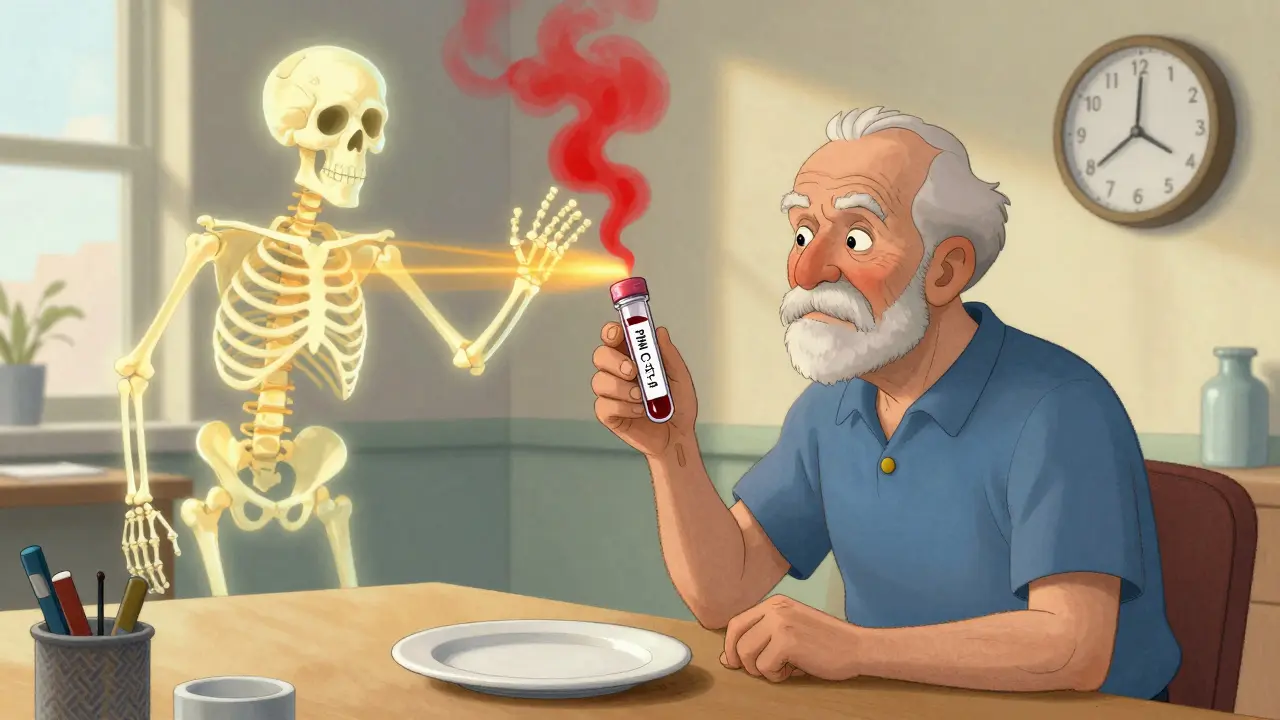
Bone isn’t static. Every day, your body breaks down old bone and builds new bone in a process called remodeling. When this balance tips - like in osteoporosis - bone breaks down faster than it rebuilds. Bone turnover markers (BTMs) are tiny proteins and fragments released into your blood or urine during this process. They’re like smoke signals from your bones, telling doctors what’s happening inside.
There are two main types:
- Formation markers: Show new bone being made. The most reliable is procollagen type I N propeptide (PINP).
- Resorption markers: Show old bone being broken down. The gold standard is β-isomerized C-terminal telopeptide of type I collagen (β-CTX-I).
These two - PINP and β-CTX-I - are the only markers recommended by the International Osteoporosis Foundation and European Calcified Tissue Society as of 2023. Other markers like osteocalcin or urinary NTx exist, but they’re less precise, more variable, and not trusted for clinical decisions.
Why Use Them Instead of Just a DXA Scan?
DXA scans are the gold standard for diagnosing osteoporosis and measuring bone density over time. But they’re slow. Even with good treatment, your spine or hip density might only improve by 1-3% in the first year. That’s barely above the scan’s own margin of error. If your doctor waits for a DXA to confirm your treatment is working, you might be taking medication for months - or years - with no idea if it’s helping.
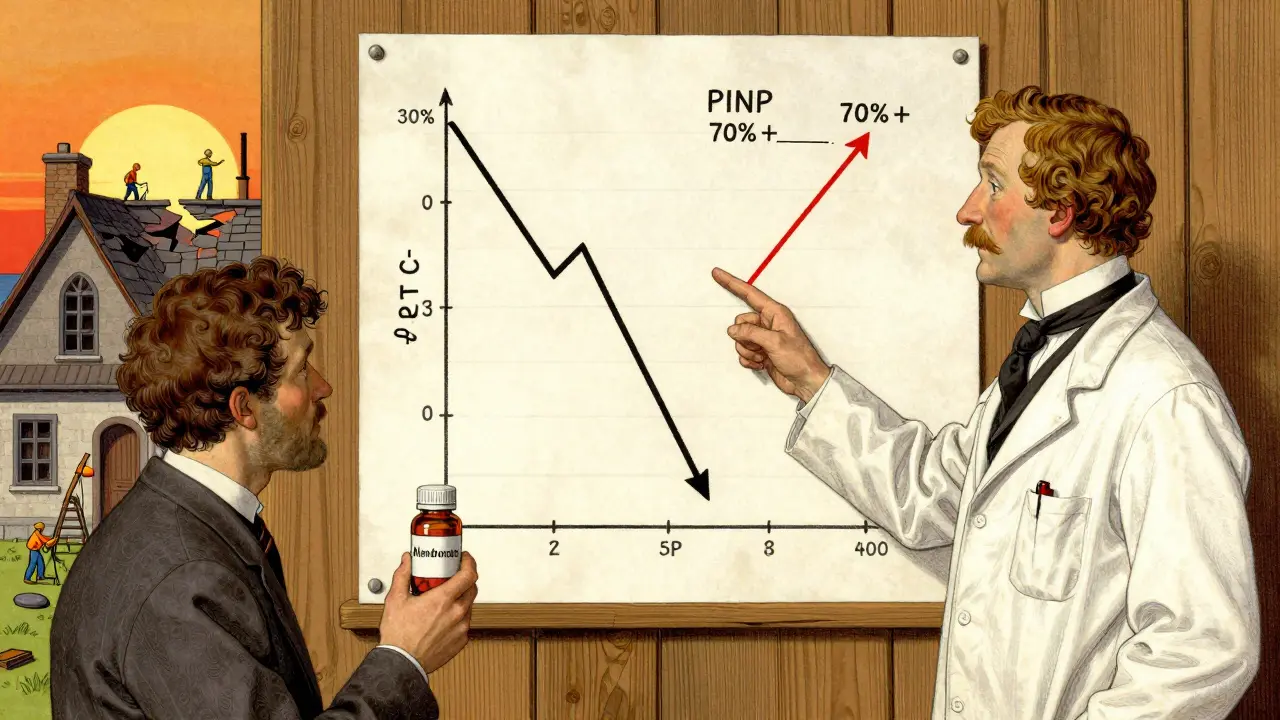
Bone turnover markers change fast. Start a bisphosphonate like alendronate? β-CTX-I levels can drop 30-50% within three months. Begin teriparatide (an anabolic drug)? PINP can spike by 70-100% in just six weeks. That’s not noise - that’s a clear signal your body is responding.
Think of it this way: DXA tells you how strong your house is. BTMs tell you if the builders are showing up every day to fix the roof.
How Are They Measured?
PINP and β-CTX-I are measured through a simple blood test. But getting accurate results isn’t as simple as walking into a lab. These markers are sensitive to timing, food, and even your daily rhythm.
For β-CTX-I:
- You must fast overnight (at least 8 hours).
- The blood must be drawn between 8 and 10 a.m. - levels can swing up to 40% if taken later in the day.
- Even a small meal the night before can raise levels by 20-30%.
PINP is more stable - it only shifts about 10-15% during the day - but doctors still recommend morning fasting samples to keep things consistent.
Lab methods matter too. Most labs use automated immunoassays, like Roche’s Elecsys system. These are precise and standardized. But not all labs follow the same protocols. As of 2023, only about 65% of US labs meet the IFCC’s recommended standards. That’s why it’s critical to use the same lab for all your tests - comparing results from different machines can mislead your doctor.
What Counts as a Good Response?
Not every drop or rise means your treatment is working. There’s a threshold - the least significant change (LSC) - below which a number change is just random noise.
For antiresorptive drugs (like bisphosphonates or denosumab):
- A drop of more than 30% in β-CTX-I at 3 months is a strong sign of response.
- A drop of more than 35% in PINP is also considered good.
For anabolic drugs (like teriparatide or romosozumab):
- A 70-100% increase in PINP within 1-3 months shows the drug is stimulating new bone growth.
If you don’t hit these targets? You might be non-adherent (not taking your pills), your medication isn’t working, or you have another issue - like kidney disease or vitamin D deficiency - interfering with your response.
A 2022 study called TRIO found patients who hit the 30% reduction target for β-CTX-I had a 1.6% lower fracture risk after just 22 weeks - a big deal when you’re trying to avoid a hip fracture.
Who Should Get Tested?
Not everyone needs BTMs. But they’re most useful in these situations:
- You’ve just started osteoporosis treatment and want to know if it’s working within months, not years.
- You’re not sure if you’re taking your medication regularly - BTMs can reveal non-adherence with 85% accuracy.
- You’re on high-risk therapy (like long-term steroids or cancer drugs) and need close monitoring.
- You have kidney disease - standard markers like β-CTX-I can be misleading, so alternatives like BALP or TRACP5b are better.
- Your DXA scan shows little change after a year, and your doctor wants to figure out why.
For most healthy postmenopausal women on standard therapy, BTMs aren’t routine - but they’re a powerful tool when you need clarity.
Limitations and Pitfalls
Bone turnover markers aren’t perfect. They reflect overall bone activity, not what’s happening at your hip or spine. Two people can have the same β-CTX-I level but very different fracture risks based on bone structure, age, or fall history.
They also vary naturally. A 20-60% fluctuation is normal between days - that’s why you need baseline and follow-up tests, not single readings. And reference ranges? Most were set using Caucasian populations. Asian women tend to have 15-20% lower baseline CTX levels. African populations show higher PINP. Using the wrong reference range can lead to misdiagnosis.
And then there’s the lab issue. If your first test is done at a hospital lab and the second at a walk-in clinic, your results might not be comparable. Always use the same lab, same method, same time of day.

What Happens If You Don’t Respond?
If your BTMs don’t drop (or rise, if you’re on an anabolic) by the target levels after three months, your doctor won’t just keep you on the same drug. They’ll investigate.
Possible reasons:
- You’re not taking your medication - BTMs can catch this better than asking you.
- You’re low on vitamin D or calcium - treatment won’t work without these.
- You have secondary osteoporosis - like hyperthyroidism, celiac disease, or kidney problems.
- The drug isn’t right for you - maybe you need to switch from a bisphosphonate to denosumab or vice versa.
One study estimated that using BTMs to identify non-responders could save $1,200-$1,800 per patient per year by avoiding unnecessary drug costs and preventing fractures.
Future of Bone Turnover Markers
The field is moving fast. Point-of-care tests - like a finger-prick device that gives you results in minutes - are in development. The FDA hasn’t approved any yet, but clinical trials are underway.
Guidelines are catching up too. The American Association of Clinical Endocrinologists is expected to update its osteoporosis guidelines in 2024 to formally recommend BTM use. In Europe, 45-60% of clinics already use them routinely. In the US, adoption is rising - especially since Medicare started covering PINP (CPT 83970) and β-CTX-I (CPT 83935) in 2020.
The goal? Make BTMs as standard as checking blood pressure before starting a new heart medication. Because bone health shouldn’t be a waiting game.
Bottom Line: What You Need to Do
If you’re on osteoporosis treatment:
- Ask your doctor if BTMs (PINP and β-CTX-I) are right for you.
- If yes, get a baseline test before starting treatment - don’t skip this.
- Repeat the test exactly three months after starting your medication. Follow all pre-test rules: fast, morning, same lab.
- Don’t panic over small changes. Look for the 30%+ drop (or 70%+ rise) - that’s what matters.
- If your numbers don’t move, work with your doctor to find out why. Don’t assume the drug is failing - it might just be you.
Bone turnover markers aren’t magic. But they’re the fastest, most direct way to know if your treatment is working - before it’s too late.
Can bone turnover markers diagnose osteoporosis?
No. Bone turnover markers can’t diagnose osteoporosis. Only a DXA scan can do that by measuring bone mineral density. BTMs show how active your bone remodeling is, not how dense your bones are. They’re used to monitor treatment, not make the initial diagnosis.
How often should I get bone turnover marker tests?
Typically, you’ll have one test before starting treatment, then again at three months to check your response. After that, unless your doctor suspects a problem, you won’t need another until your next DXA scan - usually at 12 to 24 months. Repeat testing beyond three months isn’t usually needed unless your treatment changes or you’re not responding.
Do I need to fast before the test?
Yes - especially for β-CTX-I. You must fast for at least 8 hours and have the blood drawn between 8 and 10 a.m. Food, even a light snack, can raise CTX levels by 20-30%. PINP is less affected, but fasting is still recommended to keep results consistent across tests.
Can kidney disease affect bone turnover marker results?
Yes. Kidney disease can cause false elevations in PINP and β-CTX-I because your body can’t clear them properly. In these cases, doctors may use alternative markers like bone alkaline phosphatase (BALP) or TRACP5b, which are less affected by kidney function. Always tell your doctor if you have kidney disease before getting tested.
Are bone turnover marker tests covered by insurance?
In the US, Medicare covers both PINP (CPT code 83970) and β-CTX-I (CPT code 83935) for osteoporosis monitoring as of 2020. Many private insurers follow suit. In the UK, NHS coverage varies by region - some areas use them routinely, others don’t. Always check with your provider before testing.
What if my bone turnover marker levels are normal but I still have fractures?
Normal BTMs don’t rule out fracture risk. Fractures can happen due to poor balance, low muscle mass, or previous bone damage - even if your turnover rate is normal. BTMs measure activity, not strength. Your doctor will still assess your overall fracture risk using tools like FRAX, your fall history, and your DXA results. BTMs are one piece of a bigger puzzle.
Todd Nickel
January 1, 2026Bone turnover markers are fascinating, but I’ve seen too many patients get hung up on the numbers without understanding the bigger picture. PINP and β-CTX-I are useful, sure - but they’re not a crystal ball. I’ve had people panic because their β-CTX-I dropped 28% and insisted their drug wasn’t working, when in reality, their vitamin D was borderline and their adherence was spotty. The real value isn’t in the absolute number - it’s in the trend, the context, and the clinical correlation. You need the DXA, the FRAX score, the fall risk assessment, the labs for calcium and vitamin D - all of it. Reducing osteoporosis management to two blood markers feels like trying to diagnose a car problem by only checking the fuel gauge.
And yes, I know the guidelines say to use them. But guidelines are written for populations, not individuals. If your doctor orders this test and doesn’t explain what it means in your specific case, you’re being sold a shiny tool without the manual.
Also - why do so many labs still use different assays? It’s 2024. We have reference materials. We have IFCC standards. Yet I still see patients getting results from three different labs in the same year. How is that acceptable?
And before someone says ‘just use the same lab’ - good luck if you move, change insurance, or your local hospital switches vendors. The system isn’t built for consistency. It’s built for billing.
So yes, BTMs are helpful. But they’re not magic. And we’re overpromising their utility to patients who just want to know if they’re going to break a hip next year.
Bottom line: Use them. But don’t worship them.
jaspreet sandhu
January 2, 2026This whole thing is nonsense. Bone markers? You think your body is some machine that spits out numbers and you can just fix it like a car? People have been breaking bones for thousands of years without ever hearing about PINP. Now we got labs charging $200 for a blood test that just tells you your bones are ‘active’? What’s next - a sensor in your toe that beeps when you’re about to fall?
I’ve seen old men in India walk 10 miles a day with no meds and no scans and never break a bone. Meanwhile, some American woman takes her pills, gets her ‘markers’, and still ends up in a wheelchair because she’s scared to walk outside. This isn’t medicine. It’s fear sold as science.
And don’t even get me started on fasting at 8 a.m. Who has time for that? My cousin works two jobs. She can’t even sit still for a blood test, let alone wait 8 hours without coffee. This is for rich people who can afford to waste their mornings on numbers that don’t change their lives.
DXA scans are slow? Fine. So what? Bone density doesn’t change overnight. Life doesn’t change overnight either. Maybe stop chasing numbers and start eating real food, lifting something heavy, and stopping the fear-mongering.
They call this ‘clinical reality’? I call it corporate profit dressed in lab coats.
Kristen Russell
January 3, 2026Just had my 3-month BTM test - β-CTX-I dropped 42%. I’m finally feeling like this treatment is working. No more guessing. No more ‘wait a year’ nonsense. This is the clarity I needed.
Also - yes, fast. Yes, morning. Yes, same lab. It’s not hard. Do the thing.
Thank you for writing this - I’m sharing it with my support group.
Liam George
January 4, 2026Let’s be honest - this whole bone turnover marker industry is a controlled narrative. Who funds the guidelines? Pharma. Who profits from repeat blood tests? Labs. Who gets scared into compliance? Patients.
Did you know β-CTX-I is metabolized by the kidneys? And that kidney function declines with age - but they still use the same reference ranges for 65-year-olds and 85-year-olds? That’s not science - that’s statistical manipulation.
And PINP? It’s elevated in Paget’s disease, metastatic cancer, even hyperthyroidism - but you’re supposed to ignore that unless your doctor is suspicious? That’s not monitoring - that’s a trap.
There’s a reason these markers aren’t used in Japan or China as routinely - because they know the data is noisy, confounded, and commercially exploited. We’re being sold a false sense of control. The real solution? Reduce sugar, get sunlight, move your body, and stop taking drugs that suppress your natural biology.
They call this ‘evidence-based.’ I call it corporate medicine with a lab coat.
And don’t even get me started on Medicare covering these tests. Who benefits? Not you. Not me. The system.
sharad vyas
January 6, 2026In my village in India, we treat bone weakness with turmeric milk, sunlight, and walking barefoot on the earth. No blood tests. No pills. Just tradition and time.
I understand the science here - and I respect it. But I also wonder: are we losing something when we turn every part of our body into a data point? My grandmother broke her hip at 82 and still danced at weddings. She didn’t know what β-CTX-I was. But she knew how to live.
Maybe the answer isn’t just in the numbers - but in how we live with our bodies, not against them.
Use the markers if they help you feel safe. But don’t let them make you afraid of your own skin.
There is wisdom in stillness, and strength in simplicity.
Sally Denham-Vaughan
January 7, 2026YES. I’ve been pushing my doctor for this for months. Finally got the test done after reading this - and I’m so glad I did. My β-CTX-I was sky-high, turns out I was skipping my meds because I hated the stomach upset. Now I switched to a different bisphosphonate and I’m actually taking them. This test saved me from a year of wasted time.
Also - FAST. MORNING. SAME LAB. Write it on your hand if you have to. It matters.
And if your doctor says ‘we don’t do that here’ - go to a different doctor. You deserve to know if your treatment is working. This isn’t optional. It’s basic care.
Bill Medley
January 8, 2026While the utility of bone turnover markers in treatment monitoring is well-documented in peer-reviewed literature, their clinical implementation remains subject to significant inter-laboratory variability and insufficient standardization across diverse populations. As such, their application should be contextualized within a broader diagnostic and therapeutic framework, and not treated as an isolated biomarker paradigm.
Furthermore, the economic implications of widespread adoption require further cost-benefit analysis, particularly in light of existing disparities in access to standardized laboratory infrastructure.
Recommendation: Proceed with caution, ensure protocol adherence, and maintain longitudinal consistency in testing methodology.
Richard Thomas
January 9, 2026I’ve been thinking a lot about this since my last test. I’m 71. Diagnosed with osteoporosis five years ago. Took alendronate for two years, then stopped because I got sick of the side effects. My doctor said ‘wait for the DXA’ - so I waited. Two years later, my spine density dropped 4%. I felt like I’d failed.
Then I read this. Got the BTMs done. β-CTX-I was up 60% from baseline. PINP was flat. That meant I wasn’t building bone - but I was still breaking it down. I was in a silent decline.
I restarted treatment - switched to denosumab. Three months later, β-CTX-I dropped 41%. I cried. Not because I was cured - but because I finally knew I was doing something right.
This isn’t about numbers. It’s about agency. Before, I felt like a passive patient waiting for disaster. Now I feel like I’m in the driver’s seat.
And yes - I fast. I get up early. I go to the same lab. I write it down. Because this is the first time in my life I’ve felt like my body and I are on the same team.
Thank you for writing this. Not just the science - but the humanity behind it.