

2 Feb 2026
- 12 Comments
The U.S. Food and Drug Administration doesn’t stop watching a drug or medical device once it’s on the market. In fact, that’s when the real safety work begins. Enter MedWatch - the FDA’s frontline system for tracking harmful side effects, product failures, and unexpected reactions after millions of people start using prescription drugs, over-the-counter medicines, medical devices, and even cosmetics. It’s not a secret tool. It’s not hidden behind government walls. It’s open, public, and relies on real people - doctors, nurses, patients, and manufacturers - to report when something goes wrong.
What Exactly Is MedWatch?
MedWatch, officially called the FDA Safety Information and Adverse Event Reporting Program, started in 1993. It was created because the FDA knew that clinical trials, no matter how big, can’t catch every possible problem. Trials involve thousands of people. But once a drug hits the market, it’s used by millions - including elderly patients with five other conditions, pregnant women, kids, and people taking combinations of drugs never tested together. That’s where MedWatch steps in. It’s not just a database. It’s a two-way street. First, it collects reports of bad reactions. Second, it sends out urgent safety alerts when a pattern emerges. Think of it like a national early-warning system for medical products. If a new heart rhythm issue pops up in 20 people taking the same blood thinner, MedWatch helps the FDA spot it fast - sometimes within weeks.Who Reports to MedWatch?
There are two types of reporters: those who have to, and those who can. Manufacturers, importers, and hospitals that use medical devices are legally required to report deaths or serious injuries linked to their products. For drugs, pharmaceutical companies must report any serious side effect they become aware of within 15 days. These are called mandatory reports. Then there’s everyone else: doctors, pharmacists, nurses, and patients. They report voluntarily. You don’t need permission. You don’t need to be a doctor. If you took a new medication and started having strange numbness in your hands, or if your knee implant started making noise after six months, you can file a report. In 2022, nearly half of all MedWatch reports came from patients and caregivers - not professionals. The reporting forms are simple. Healthcare providers use Form FDA 3500. Consumers use the same form, just filled out differently. The FDA doesn’t demand perfect medical jargon. They want details: What was the medicine or device? When did the problem start? What happened? Did you go to the hospital? Did it get better? The more specific, the better.What Happens After You Submit a Report?
Every report lands in the FDA Adverse Event Reporting System (FAERS), a massive digital archive with over 28 million entries. But it’s not just stored. It’s mined. The FDA uses advanced algorithms to find patterns. One method, called the Proportional Reporting Ratio (PRR), compares how often a side effect shows up with a certain drug versus all other drugs. If a rare liver injury appears 10 times more often with Drug X than with anything else, that’s a red flag. Another tool, the Bayesian Confidence Propagation Neural Network (BCPNN), looks for unexpected combinations - like a new seizure risk tied to a drug taken with a common vitamin supplement. These signals are reviewed by a small team of just 120 experts. That’s right - 120 people analyze over 1.2 million reports every year. They don’t confirm causation. They look for signals. Then they decide: Is this serious enough to warn the public? To change the label? To pull the product? One of the most famous cases was the 2021 recall of Allergan’s textured breast implants. MedWatch reports showed a rare type of lymphoma linked to the texture. Within 45 days of the signal being flagged, the FDA ordered a nationwide recall. That’s the power of the system - when it works.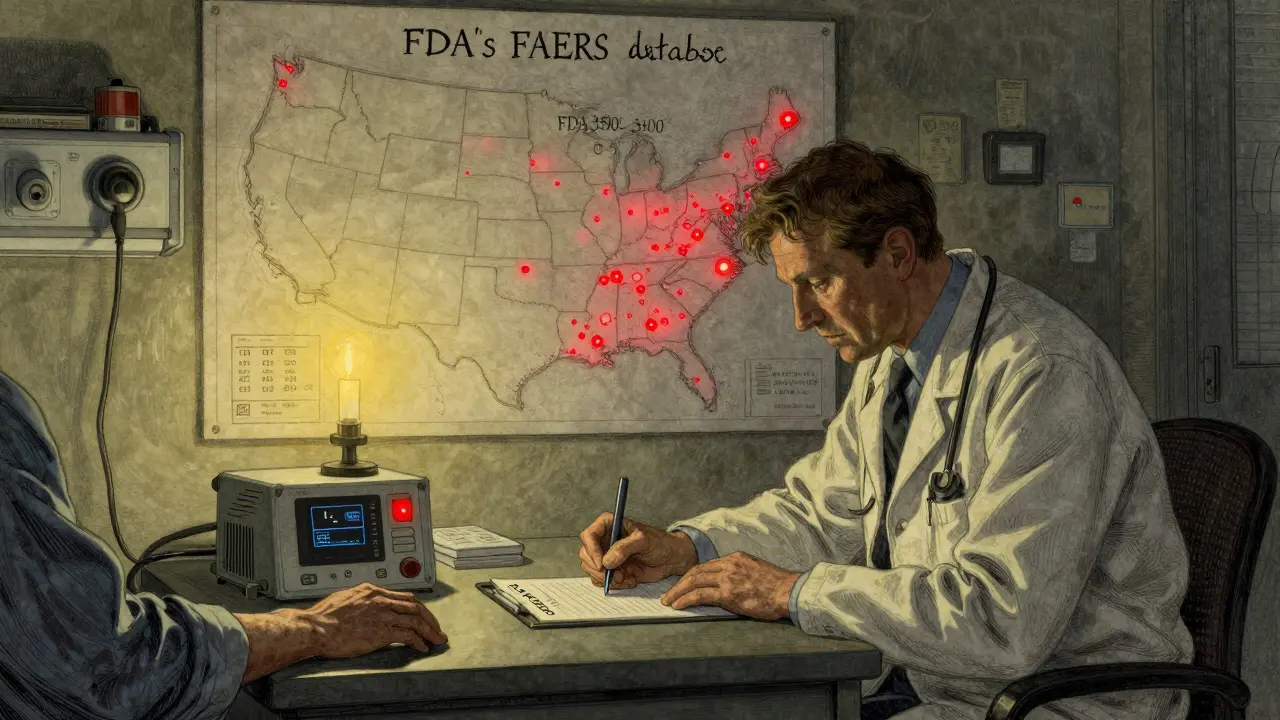
Why So Many Reports Go Unnoticed
Here’s the uncomfortable truth: MedWatch is only as good as the reports it gets. Experts estimate that only 1% to 10% of all adverse events are ever reported. That means for every serious reaction that makes it into the system, 9 to 99 others vanish. Why? Time. Complexity. Confusion. A 2021 study found that doctors spend 15 to 20 minutes filling out a single MedWatch report. In a busy clinic, that’s hard to justify. Even with electronic health record integrations cutting that time down to 8-12 minutes for some, many still skip it. Patients? They often don’t know how to report. Or they think their symptom wasn’t “serious enough.” Or they don’t know where to start. A 2022 survey by the National Consumers League found that 68% of patients who tried to file a report got stuck on medical terms. One woman reported “my leg turned purple after the shot” - but didn’t know the name of the vaccine. The system couldn’t process it. She gave up. And even when reports are filed, many are incomplete. ProPublica found that 17% of submissions lacked key details like the patient’s age, medical history, or time between taking the drug and the reaction. Without that, the FDA can’t connect the dots.Real Impact: When MedWatch Changed Things
The system isn’t perfect - but it’s saved lives. In 2019, Dr. Sarah Johnson, an oncologist at MD Anderson, noticed a pattern in her patients taking Keytruda, a cancer immunotherapy. Several were developing sudden, severe immune reactions - not the typical fatigue or rash, but inflammation of the heart and lungs. She filed a MedWatch report. Within 90 days, the FDA issued a safety alert. The drug’s label was updated. Doctors started screening patients differently. That’s direct impact. Another example: the 2022 label update for Xarelto, a blood thinner. A pharmacist in Ohio submitted five reports over three years about unexplained bleeding in elderly patients. The FDA reviewed those alongside others. The warning about bleeding risk in patients over 75 was strengthened. That’s how change happens - one report at a time.What’s New in MedWatch?
The FDA isn’t sitting still. In September 2023, they launched MedWatch Direct - a new API system that lets electronic health records like Epic and Cerner send reports automatically. No more manual forms. When a patient has a serious reaction, the system flags it and pushes a pre-filled report to the FDA. Pilot programs are already in 47 major hospitals. By mid-2024, the FDA plans to roll out AI tools that scan clinical notes for phrases like “arrhythmia after starting drug” or “swelling after implant.” That could pull hundreds of hidden reports out of doctors’ notes that were never formally submitted. They’re also testing blockchain to verify report authenticity - stopping fake or duplicate submissions. And they’ve increased funding to $47.8 million in 2024, a 12% jump from last year. But experts warn: tech won’t fix the core problem. If people don’t report, even the smartest AI won’t help.
How to File a MedWatch Report (Simple Steps)
You don’t need to be a medical expert. Here’s how to do it in five minutes:- Go to www.fda.gov/medwatch
- Click “Report a Problem”
- Choose “Consumer/Patient” or “Health Professional”
- Fill in what you know:
- Name of the drug, device, or product
- When you started using it
- What happened (describe symptoms, not just “I felt bad”)
- How long it lasted
- Did you go to the doctor? Did you stop using the product?
- Your age and sex (if comfortable)
- Submit. You can do it online, by fax (1-800-FDA-0178), mail, or phone (1-800-FDA-1088).
What MedWatch Can’t Do
It’s important to understand the limits. MedWatch doesn’t:- Confirm if a drug caused a reaction - only that the two happened together.
- Replace clinical trials. It finds signals, not proof.
- Offer medical advice. If you’re having a bad reaction, call your doctor - don’t wait for a MedWatch alert.
- Act instantly. It takes weeks to analyze patterns and issue warnings.
Final Thought: Your Report Matters
MedWatch isn’t just government bureaucracy. It’s a safety net woven from the experiences of real people. The system works because someone - a nurse, a grandparent, a pharmacist - took the time to report something that felt wrong. You don’t need to be an expert. You don’t need to understand pharmacology. You just need to notice something unusual and speak up. One report might not change the world. But 100? 1,000? That’s how the FDA finds the next hidden danger before it hurts more people. If you’ve ever had a side effect that surprised you - or saw someone else have one - don’t ignore it. Report it. It’s simple. It’s fast. And it might save someone’s life.Is MedWatch only for prescription drugs?
No. MedWatch accepts reports for prescription drugs, over-the-counter medicines, vaccines, medical devices like pacemakers and implants, biologics (like insulin or monoclonal antibodies), cosmetics, and even hemp-derived cannabinoid products. If it’s regulated by the FDA and you think it caused a problem, you can report it.
Do I need to prove the product caused the problem to report it?
No. MedWatch collects suspected adverse events - even if you’re not sure the product caused it. The FDA’s job is to look for patterns. If 50 people report the same rare reaction after using the same device, that’s enough to trigger an investigation. You don’t have to be certain - just concerned.
Can I report a problem for someone else?
Yes. You can report for a family member, friend, or patient under your care. You’ll be asked to provide basic info about the person (age, sex) and your relationship to them. You don’t need legal permission to report a safety concern.
How long does it take for the FDA to act on a report?
It varies. For life-threatening signals - like a new heart rhythm issue tied to a popular drug - the FDA can issue a safety alert within weeks. For less urgent issues, analysis may take months. The system doesn’t respond to single reports; it waits for patterns. One report is a whisper. A hundred similar reports become a scream.
Are MedWatch reports public?
The FDA publishes aggregated data from MedWatch in its FAERS database, but personal details like names, addresses, and specific medical records are never made public. Reports are de-identified to protect privacy. You can search the public database to see what kinds of reactions have been reported for a specific drug, but you can’t trace them back to individuals.
What if I made a mistake on my report?
You can submit a new report with corrected information. The FDA’s system tracks reports by unique identifiers, so they can link updates to the original. Don’t worry about getting it perfect the first time. Better to submit something incomplete than nothing at all.
Harriot Rockey
February 3, 2026Just filed my first MedWatch report after my mom had that weird rash from her new blood pressure med 🤕💡 Seriously, it took 7 minutes. No doctor needed. If you’ve ever thought "hmm, that’s not right" - just report it. You’re literally helping people you’ll never meet. ❤️
Samuel Bradway
February 4, 2026My aunt’s knee implant started clicking like a broken hinge after 18 months. She didn’t know where to report it. I found the FDA site, filled it out for her. Took 10 mins. She thought it was ‘just noise’ - turns out, 3 other people had the same issue. Glad we did it.
Caleb Sutton
February 4, 2026MedWatch is a trap. The FDA uses these reports to justify more control. They don’t care about you. They care about liability. That ‘120 experts’ team? They’re just paper pushers for Big Pharma. The real danger is hidden in the 99% of reports that never get seen.
pradnya paramita
February 5, 2026From a pharmacovigilance standpoint, the PRR and BCPNN algorithms employed by FAERS are statistically robust for signal detection, though they suffer from underreporting bias and confounding due to polypharmacy. The 1-10% reporting rate is consistent with global ADR surveillance systems. The integration of NLP into EHRs represents a significant leap forward in passive surveillance efficiency.
Prajwal Manjunath Shanthappa
February 6, 2026Oh, so now we’re supposed to trust the FDA? The same agency that approved Vioxx? The same one that ignored the thalidomide warnings? And you think a FORM is going to fix this? The entire system is a charade - a PR stunt to make you feel like you’re doing something while they quietly bury the data!
Katherine Urbahn
February 7, 2026It is imperative to underscore that the voluntary nature of patient reporting constitutes a critical vulnerability within the framework of pharmacovigilance. The absence of mandatory reporting by laypersons, coupled with inconsistent documentation standards, renders the system inherently unreliable. One must question the scientific validity of conclusions drawn from such fragmented, unverified inputs.
Shelby Price
February 8, 2026My friend took that new migraine med and got dizzy as heck. She didn’t know if it was the drug or just stress. She reported it anyway. Three weeks later, the FDA added a warning about dizziness. Kinda wild that a random person’s report helped change a label.
Jesse Naidoo
February 10, 2026Wait, so if I report my weird side effect, does that mean someone will call me? Like, a real person? Do they follow up? I’m kinda scared they’ll ask for my medical records. I don’t even know what my insurance code is for my last prescription.
Harriot Rockey
February 11, 2026Nah, they don’t call. It’s totally anonymous. You don’t even need to leave a name. Just describe what happened - even if you’re not sure. That’s the whole point. The system doesn’t need you to be right. It just needs you to speak up. 😊
Lorena Druetta
February 13, 2026To every individual reading this: Your voice matters. Even if you feel insignificant. Even if you think your experience is too small. One report, multiplied by thousands, becomes a lifeline for someone else. Please - take five minutes. It is not just a form. It is an act of compassion.
Zachary French
February 13, 2026Big Pharma loves MedWatch. It’s their get-out-of-jail-free card. They get to say ‘we reported everything!’ while the real bad stuff slips through. And don’t even get me started on the ‘AI scanning notes’ thing - they’re just trying to automate away accountability. Wake up people. This isn’t safety. It’s damage control with a pretty website.
Daz Leonheart
February 15, 2026Just wanted to say thanks to everyone who’s reported something. I know it’s annoying. I know it feels like yelling into the void. But I’ve seen what happens when no one speaks up. It’s not glamorous. But it’s real. Keep going. You’re doing better than you think.