
1 Mar 2026
- 15 Comments
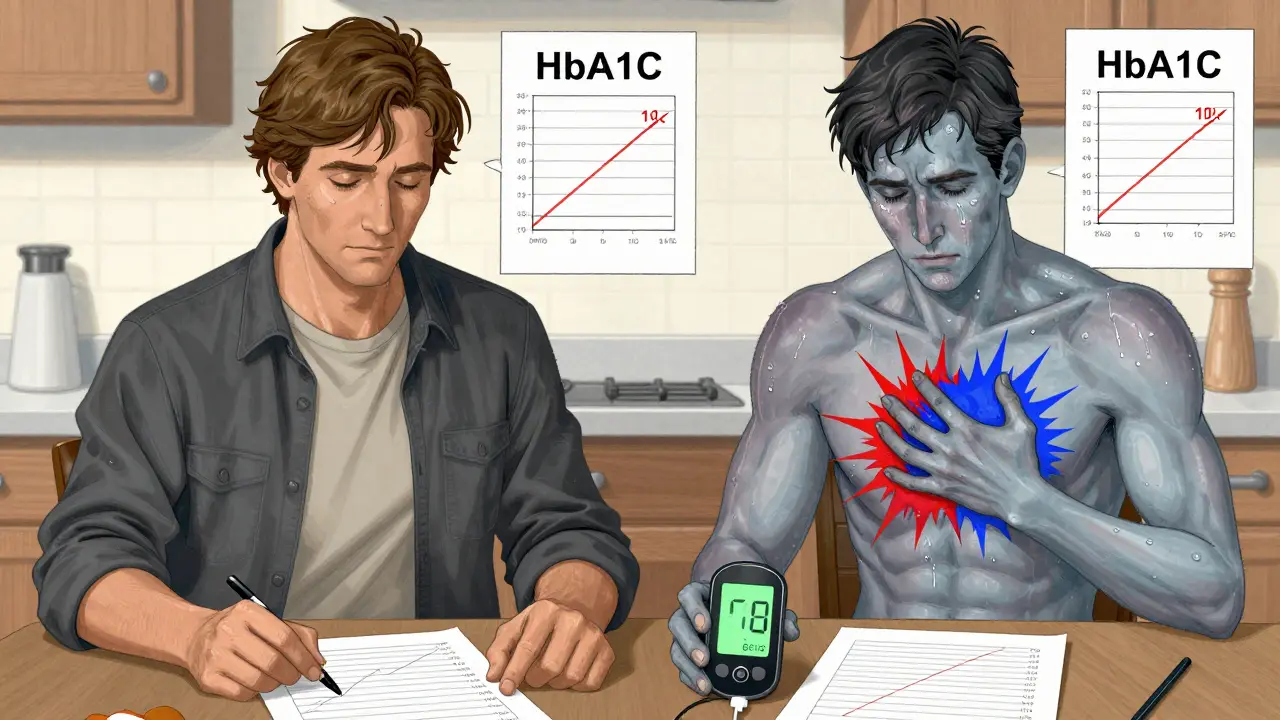
Imagine two people with the same HbA1c of 7%. One feels fine, never crashes after meals, and sleeps through the night without waking up sweaty or shaky. The other gets dizzy after lunch, wakes up with a heart pounding at 3 a.m., and has no idea why. Their numbers look identical on paper-but their real-life experiences are worlds apart. That’s the blind spot HbA1c leaves behind. Enter time in range (TIR): a daily, real-time view of your blood sugar that actually shows you what’s happening, not just what averaged out over three months.
What Time in Range Really Means
Time in range isn’t a buzzword. It’s a simple, powerful number: the percentage of time your glucose stays between 70 and 180 mg/dL (3.9-10.0 mmol/L). For most adults with type 1 or type 2 diabetes, the goal is to hit at least 70%-that’s 17 hours out of every 24. Sounds easy? It’s not. Most people spend less than half their day in that sweet spot, even if their HbA1c looks good.
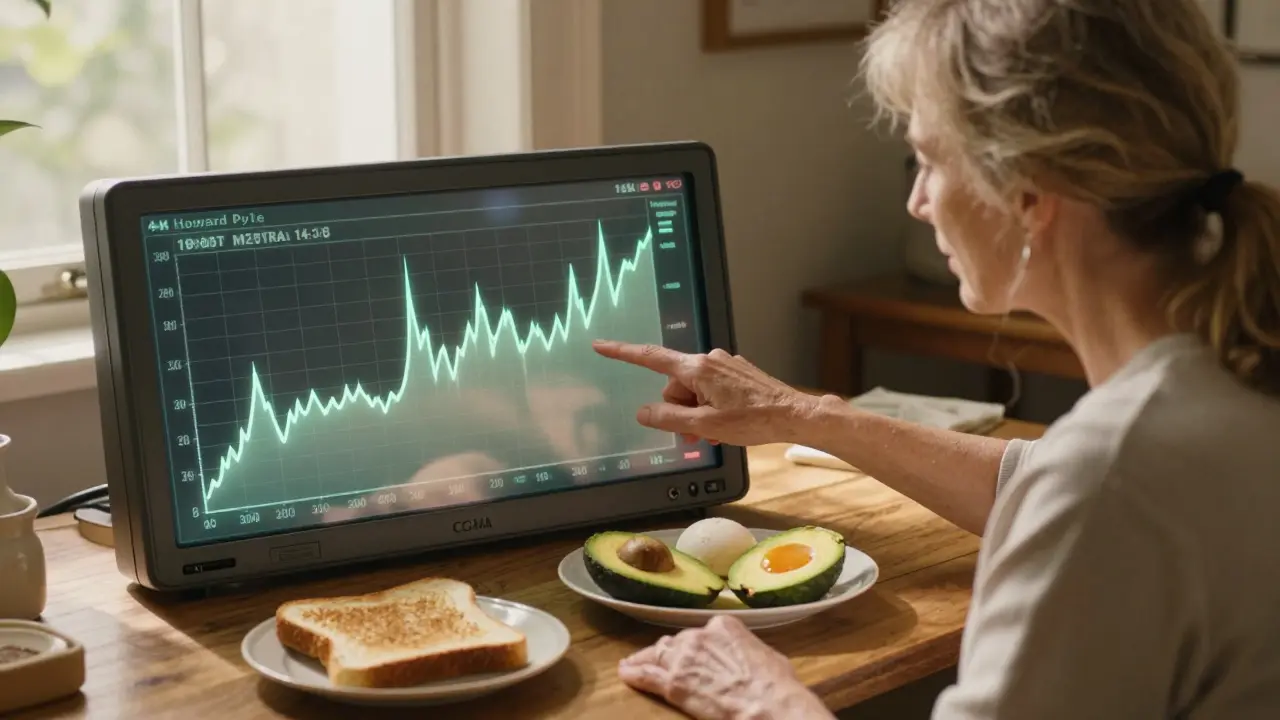
This metric comes from continuous glucose monitors (CGMs), devices that check your sugar every 5 minutes, 24/7. Over a 14-day wear, that’s over 4,000 data points. That’s not an average. That’s a story. It shows you when your sugar spikes after toast, drops after walking, or creeps up after stress. HbA1c tells you the final grade. TIR shows you every quiz, every late-night cram session, every time you blanked on the test.
Why TIR Beats HbA1c for Daily Control
HbA1c is like a report card. It’s useful, but it hides the details. You could have an HbA1c of 6.8%-perfect-while spending 12 hours a day above 200 mg/dL and 3 hours below 60 mg/dL. That’s dangerous. You’re swinging wildly, and your body is paying the price. TIR catches that. It tells you how often you dip too low, how long you’re stuck too high, and how much your sugar jumps around.
Studies show two people with identical HbA1c levels can have wildly different TIR scores-and very different risks. One might spend 85% of the day in range, rarely going below 70. The other? Only 40%. That second person is far more likely to have complications down the road, even if their A1C looks fine. TIR reveals the hidden patterns HbA1c sweeps under the rug.
It’s not just about avoiding lows and highs. It’s about stability. The coefficient of variation (CV)-a measure of how much your sugar fluctuates-is just as important as the average. High CV? Even if your TIR is decent, your body is under constant stress. Low CV? That’s the quiet, steady rhythm your pancreas used to give you.
The Numbers That Matter
When you look at your CGM report, you’re not just seeing one number. You’re seeing three:
- Time in Range (TIR): 70-180 mg/dL. Target: ≥70%
- Time Below Range (TBR): Below 70 mg/dL. Target: <4% (less than 1 hour/day)
- Time Above Range (TAR): Above 180 mg/dL. Target: <25% (less than 6 hours/day)
Some people aim even tighter: Time in Tight Range (70-140 mg/dL). That’s closer to what non-diabetic people experience. It’s not for everyone-especially if you’re prone to lows-but for those who can manage it, it’s linked to better long-term outcomes. Research in 2025 (Spartano et al.) showed that people without diabetes spend nearly 80% of their day in this tighter zone. It’s a goal, not a requirement.
And don’t ignore severe hypoglycemia. Time below 54 mg/dL should be under 1%. That’s not a blip-that’s a medical emergency waiting to happen.
How CGM Turns Data Into Action
Here’s the real power of TIR: it turns guesswork into strategy.
One woman, 58, type 2 diabetes, was told her A1C was “good.” But her CGM showed her sugar spiking to 220 mg/dL every morning after oatmeal. She thought it was healthy. Her doctor didn’t question it. Her TIR was stuck at 55%. She switched to eggs and avocado for breakfast. Within two weeks, her TIR jumped to 78%. No medication change. Just one food swap.
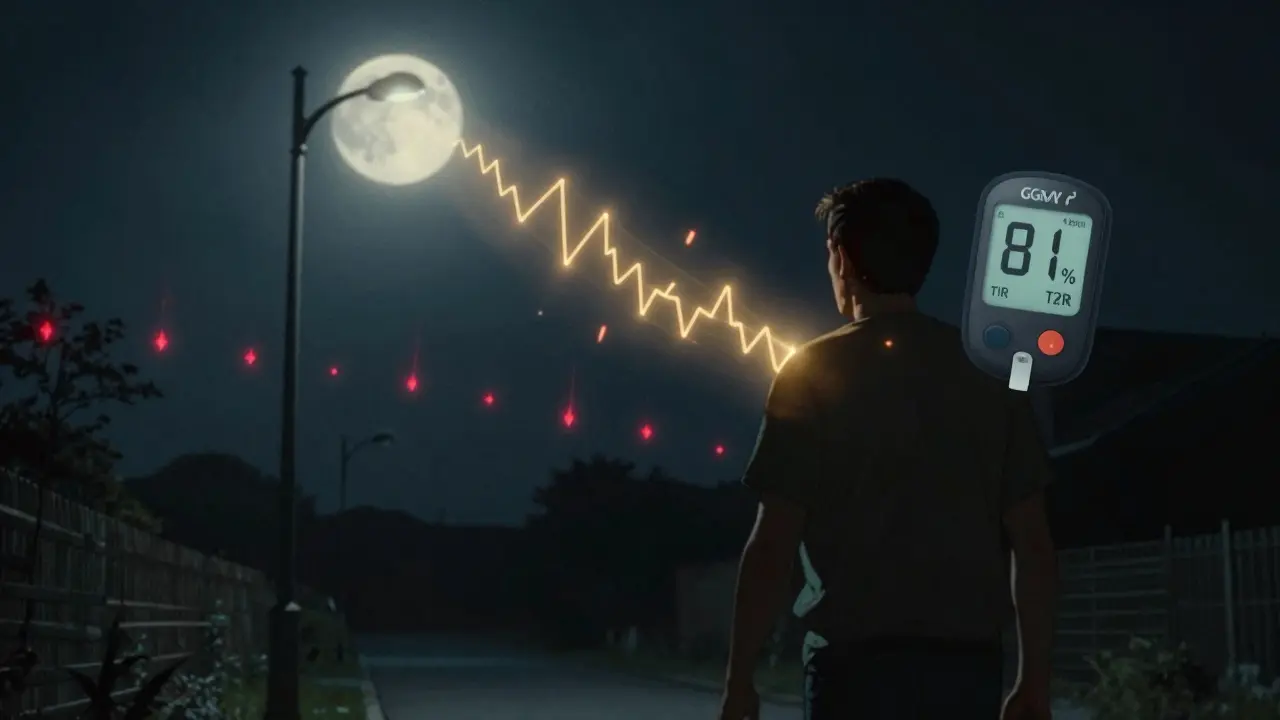
Another man, 42, type 1, noticed his sugar dropped after evening walks. But he didn’t know how much. His CGM showed a 40 mg/dL drop every night after 30 minutes of walking. He started timing his evening insulin dose around it. His nighttime lows vanished. His TIR climbed from 62% to 81%.
CGM doesn’t just show you your sugar. It shows you why. It connects the dots between food, movement, sleep, stress, and meds. You start seeing patterns you never knew existed.
Who Should Use TIR? It’s Not Just for Insulin Users Anymore
For years, CGMs were seen as tools for people on insulin. But in 2025, the American Diabetes Association changed the game. Their new Standards of Care say: “CGM should be considered in adults with type 2 diabetes treated with glucose-lowering medications other than insulin.”
That’s huge. It means if you’re on metformin, GLP-1s, SGLT2 inhibitors, or even just diet and exercise-you can still benefit from knowing your glucose patterns. You don’t need to be on insulin to deserve this level of insight.
Studies show non-insulin users who use CGM reduce their A1C, increase TIR, and cut time spent above 180 mg/dL. It’s not magic. It’s awareness. And awareness leads to better choices.
Getting Started: What You Need to Know
You don’t need to be a tech expert. But you do need to wear the device long enough to get meaningful data. The 2019 International Consensus says: at least 70% of your CGM wear time must be active. That means if you’re wearing it for 14 days, you need at least 10 days of continuous, valid data. No skipping nights. No peeling it off because it’s “itchy.”
Most CGMs last 10-14 days. Some require fingerstick calibrations. Others don’t. You’ll get a report from your provider or app showing TIR, TBR, TAR, mean glucose, and CV. Don’t ignore the graphs. The bar chart isn’t just pretty-it’s your roadmap.
Start with a 14-day trial. Look for patterns:
- Does your sugar spike after coffee?
- Does it drop after yoga?
- Do you stay high after takeout, even if it’s “low-carb”?
Write it down. Talk to your care team. Adjust. Repeat. You’re not trying to be perfect. You’re trying to understand.
Barriers? Yes. But They’re Falling Fast
Cost used to be the biggest roadblock. CGMs were expensive. Insurance often only covered them for insulin users. But things are changing. Medicare now covers CGM for many type 2 diabetes patients. Private insurers are following. The global CGM market is projected to hit $18.6 billion by 2030-because demand is rising.
And it’s not just about devices. It’s about access to education. Diabetes educators are now trained to interpret TIR data. The Association of Diabetes Care & Education Specialists (ADCES) has formalized training on glycemic metrics. You’re not alone in figuring this out.
What’s Next? AI, Tighter Ranges, and Real-Time Guidance
The future is here. Some CGM apps already use AI to suggest: “Your sugar spikes after pasta. Try eating veggies first.” Others flag: “You’re likely to drop low in 30 minutes. Eat a snack.”
Researchers are now linking specific TIR percentages to long-term complications. Early data suggests spending 80%+ in range cuts your risk of eye, nerve, and kidney damage significantly. We’re still learning-but the trend is clear: more time in range = fewer complications.
And the target range? It might get tighter. As we learn more about glucose patterns in people without diabetes, the ideal zone could shift. For now, 70-180 mg/dL is the standard. But if you’re stable, low-risk, and motivated? 70-140 might be worth aiming for.
Bottom Line: TIR Is Your Daily Compass
You don’t need to obsess over every number. But you do need to pay attention. TIR isn’t about perfection. It’s about awareness. It’s about knowing when your body is in balance-and when it’s not.
If you’re not using a CGM yet, ask your doctor. If you are, don’t just glance at the graph. Study it. Test your assumptions. Change one thing at a time. Track the results.
Your HbA1c will thank you. But more importantly, your body will thank you-for the energy, the sleep, the confidence, and the peace of mind that comes from knowing, for once, exactly what’s happening inside you.
What is the ideal Time in Range percentage for most adults with diabetes?
The recommended target for most nonpregnant adults with type 1 or type 2 diabetes is at least 70% of the day spent within the glucose range of 70-180 mg/dL (3.9-10.0 mmol/L). This aligns with the American Diabetes Association’s 2025 Standards of Care and corresponds to an HbA1c of approximately 7%. Higher targets, such as 75-80%, may be appropriate for those with fewer hypoglycemia risks or those aiming for tighter control.
How does Time in Range differ from HbA1c?
HbA1c measures average blood glucose over the past 2-3 months, giving you a single number. Time in Range (TIR), measured through continuous glucose monitoring (CGM), shows how much time you spend in, above, or below your target range each day. TIR reveals daily patterns-like spikes after meals or overnight lows-that HbA1c hides. Two people can have the same HbA1c but very different TIR scores, meaning one has stable glucose and the other has dangerous swings.
Can people with type 2 diabetes benefit from CGM even if they don’t use insulin?
Yes. The 2025 American Diabetes Association Standards of Care explicitly recommend CGM for adults with type 2 diabetes who are on non-insulin glucose-lowering medications like metformin, GLP-1s, or SGLT2 inhibitors. Studies show these patients improve their TIR, reduce time above 180 mg/dL, and lower HbA1c just by seeing their glucose patterns. Awareness leads to better food choices, activity timing, and medication adherence-even without insulin.
How long do I need to wear a CGM to get accurate Time in Range data?
To get clinically meaningful TIR data, you need to wear your CGM for at least 14 days with at least 70% active monitoring time. That means no more than 4.2 days of skipped or invalid data during the 14-day period. Shorter periods (like 7 days) can show trends, but 14 days gives you a full picture of weekly patterns-including weekends and weekday routines.
What should I do if my Time in Range is low?
Start by looking at your CGM graph. Identify patterns: Do you spike after certain meals? Drop after exercise? Stay high at night? Make one small change at a time-like swapping a carb-heavy breakfast for protein and fat, or walking 15 minutes after dinner. Track your results over 1-2 weeks. Talk to your diabetes educator or provider. They can help you adjust medications or timing if needed. Small, consistent changes often lead to big improvements in TIR.
Levi Viloria
March 2, 2026I've been using a CGM for 8 months now and honestly? It changed everything. I thought my A1c was good enough, but seeing my glucose swing from 210 to 65 after dinner? That was a wake-up call. I stopped eating rice at night. No more 3 a.m. heart palpitations. Simple fix, big difference.
Sharon Lammas
March 4, 2026This is the first time I've seen someone explain TIR like a story instead of a statistic. It made me feel seen. I’ve been struggling with unexplained fatigue and no one ever asked me about my daily patterns. Just A1c. Always A1c.
Chris Beckman
March 5, 2026TIR is just another metric the med industry invented to sell more devices. You don’t need a CGM to know if you feel like crap after carbs. My grandpa managed diabetes with a fingerstick and willpower. You kids and your gadgets.
Dean Jones
March 5, 2026The real tragedy isn't the numbers-it's the silence around glycemic variability. We treat diabetes like a math problem where the answer is always A1c, but the equations are written in blood sugar spikes, sleepless nights, and anxiety over snacks. The body doesn't average. It endures. And we're not listening.
Ivan Viktor
March 7, 2026So let me get this straight. You’re telling me I’ve been wasting my time obsessing over A1c while my glucose is doing the cha-cha all day? Cool. Thanks for the heads up. Now I gotta buy a new sensor. Again.
Gretchen Rivas
March 9, 2026TIR + CV together are game changers. I used to think '70% TIR' was good enough. Then I saw my CV was 42%. My body was in fight-or-flight mode all day. Now I aim for CV under 30. Stability > averages.
Mike Dubes
March 11, 2026I didn't believe in CGMs until I saw my sugar drop after a 10-minute walk after dinner. Just ten minutes. No meds, no diet overhaul. I started walking after every meal. My TIR went from 52% to 78% in 6 weeks. Sometimes the fix is that simple.
Helen Brown
March 11, 2026Who’s really behind this? Big Pharma? The sensor companies? They don’t want you to know that insulin resistance can be reversed with food and sleep. This is just another way to keep you dependent. Watch out.
John Cyrus
March 12, 2026TIR is a scam if you don't track your carb intake too. You can have perfect TIR and still eat garbage. It's not the monitor that fixes you it's discipline. And most people don't have that. They just want a magic device to do the work for them
John Smith
March 13, 2026A1c is the lazy man’s metric. TIR? That’s the real talk. I used to think I was doing fine until my CGM showed me I was in range less than 40% of the time. I was living in a sugar rollercoaster and my doctor didn’t even blink. Now I’m the one asking the questions.
marjorie arsenault
March 14, 2026I teach diabetes self-management. I tell my patients: Your CGM isn’t a punishment. It’s a map. You’re not failing. You’re learning. Every spike, every dip-it’s data, not doom. Small shifts, big results.
Shivam Pawa
March 14, 2026TIR and CV are the new gold standard in metabolic health. The clinical evidence is robust. HbA1c is a lagging indicator, whereas TIR captures real-time glycemic dynamics. For insulin-sensitive individuals, the correlation between low CV and reduced oxidative stress is well-documented in peer-reviewed literature.
Jane Ryan Ryder
March 16, 2026America’s obsession with metrics is why we’re all sick. We track steps, sleep, glucose, heart rate, and still we’re dying. Maybe we should stop measuring and start living. Or maybe just eat less sugar. Radical idea, I know.
Callum Duffy
March 17, 2026It is indeed a profound observation that the conventional reliance upon HbA1c as the sole arbiter of glycaemic control may inadvertently obscure clinically significant fluctuations in interstitial glucose concentration. The temporal resolution afforded by continuous glucose monitoring affords a more nuanced, individualised understanding of metabolic physiology.
Richard Elric5111
March 18, 2026We have reduced the complexity of human physiology to a percentage. We have turned a living, breathing, fluctuating system into a KPI. TIR is not the solution-it is the symptom of a system that has forgotten that health is not a number, but a rhythm. And rhythms cannot be optimized. They must be respected.