
15 Dec 2025
- 10 Comments
Bisphosphonate-Calcium Timing Calculator
How to Use This Tool
Enter the time you took your bisphosphonate. The tool will calculate when you can safely take calcium without reducing your medication's effectiveness.
Calcium Timing Window
Your Safe Calcium Window
You can take calcium at or later. For maximum effectiveness, wait until .
When you’re prescribed a bisphosphonate for osteoporosis, you’re not just getting a pill. You’re getting a timing puzzle-one that can make or break your bone health. Take your calcium too soon after your bisphosphonate? You might as well have thrown the pill away. Take it too late? You could be missing out on the full protection your bones need. This isn’t guesswork. It’s science. And it’s the difference between preventing a fracture and ending up in the hospital.
Why Bisphosphonates Are a Big Deal
Bisphosphonates-like alendronate (Fosamax), risedronate (Actonel), and zoledronic acid (Reclast)-are the most common drugs used to treat osteoporosis. They don’t build new bone. Instead, they stop your body from breaking it down too fast. They target osteoclasts, the cells that chew away at bone. By shutting these down, bisphosphonates help keep your bone density from slipping. Studies show they reduce the risk of spine fractures by up to 50% and hip fractures by 20-25%. That’s huge. For someone over 65, a hip fracture isn’t just a broken bone-it’s a 20% chance of dying within a year. But here’s the catch: bisphosphonates are picky. They’re absorbed poorly. Only about 1% of the pill you swallow actually gets into your bloodstream. The rest? It just passes through. And what blocks that tiny 1%? Calcium.The Calcium Problem: When Good Things Fight
Calcium is essential. Your body needs it to build bone, and doctors recommend 1,000-1,200 mg per day for most adults with osteoporosis. But when calcium and bisphosphonates meet in your stomach, they stick together like glue. That chemical bond turns both into an insoluble mess-something your gut can’t absorb. Research shows this can slash bisphosphonate absorption by up to 90%. That means if you take your calcium at the same time, you’re not just wasting the calcium-you’re wasting the drug. It’s not just theory. A 2006 study by Procter & Gamble found that 40% of patients were taking calcium supplements right after or even with their bisphosphonate. That’s not a small mistake. That’s a treatment failure. And it’s not because people are careless-it’s because the instructions are confusing.The Exact Rules: When to Take What
Here’s the only way this works:- Take your bisphosphonate first thing in the morning, on an empty stomach.
- Swallow it with a full glass of plain water-no coffee, no juice, no soda.
- Stay upright for at least 30 to 60 minutes. No lying down. No bending over. This keeps the pill from sitting in your esophagus and causing irritation.
- Wait at least 30 minutes (ideally 60) before eating, drinking anything else, or taking any other medication-including calcium.
- Take your calcium supplement at lunch or dinner, not with your morning pill.
Why People Keep Getting It Wrong
It’s not that people don’t care. It’s that the regimen is brutal. You have to wake up, take a pill, wait an hour, then go about your day without food or drink. Then later, you have to remember to take calcium again. For many, especially older adults juggling multiple meds, this is too much. A 2022 survey by the National Osteoporosis Foundation found that 58% of patients quit their bisphosphonate within the first year. Why? The #3 reason: “Too hard to manage the timing.” Real people say it plainly on forums like Reddit’s r/Osteoporosis. One user wrote: “I took my Fosamax and then ate breakfast because I was hungry. I thought the calcium was the important part. I had no idea I ruined the whole thing.” Another said: “I started taking calcium at night and suddenly I didn’t feel like I was being punished every morning.”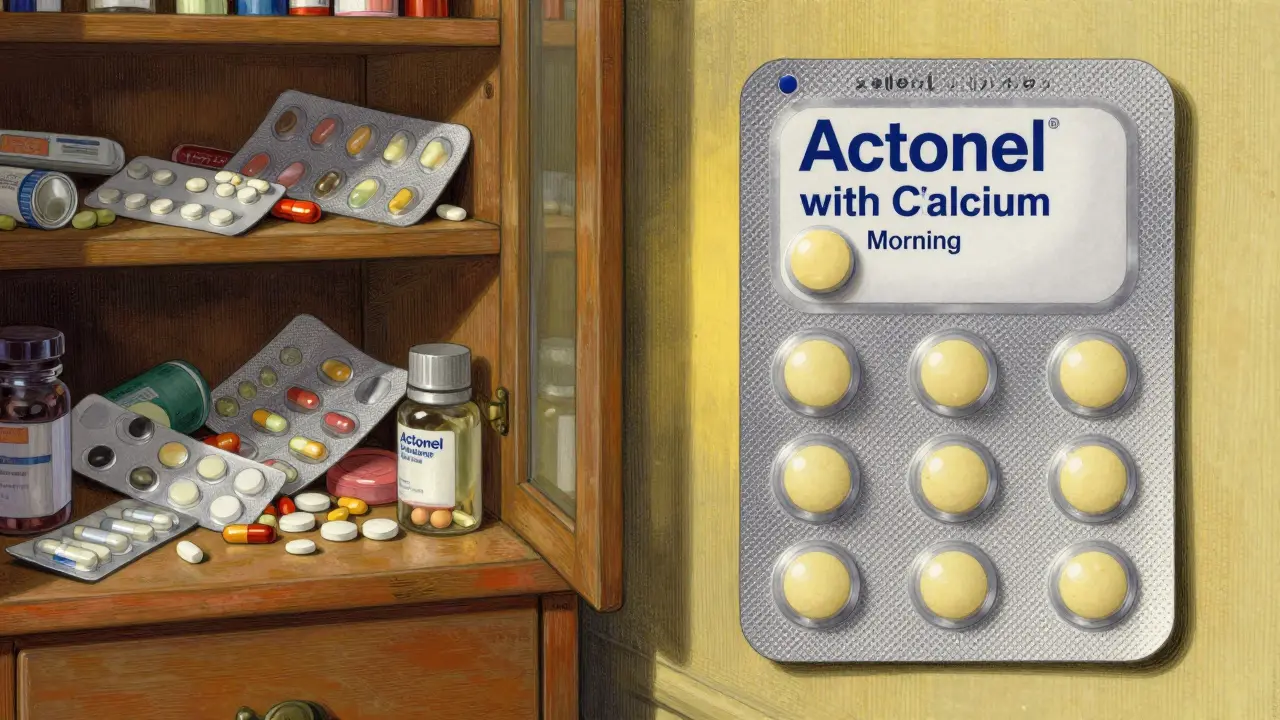
The Smart Fix: Combination Packs
Some drug companies noticed this problem and built a solution. Actonel with Calcium is a blister pack that separates one risedronate tablet from six calcium tablets. The packaging shows you exactly when to take each. One pill in the morning. Six calcium pills spread through the day. In clinical tests, patients using this system were 28% more likely to take their meds correctly. On Drugs.com, users gave it a 4.2/5 rating-with comments like: “The calendar on the pack saved me.” If your doctor hasn’t mentioned this option, ask. It’s not magic. But it removes the guesswork.What About Vitamin D?
You can’t talk about calcium without vitamin D. Your body needs vitamin D to absorb calcium. If you’re low on D, even perfect calcium timing won’t help. Experts recommend 800-1,000 IU of vitamin D daily. Many multivitamins have 400-600 IU. That’s not enough. You may need a separate supplement. Get your levels checked. Don’t assume you’re fine.The Risks: What You’re Really Balancing
Some people worry about rare side effects-like osteonecrosis of the jaw (ONJ) or atypical femur fractures. The truth? These are extremely rare. For every 10,000 people taking bisphosphonates for three years, only 1-2 might develop ONJ. The number needed to treat to prevent one hip fracture? Just 44. That means for every 44 high-risk patients treated, one hip fracture is avoided. For most, the risk of breaking a bone is far greater than the risk of a rare side effect. Dr. Ethel Siris at Columbia University puts it plainly: “The fear of a 0.1% side effect shouldn’t stop someone from avoiding a 20% chance of dying from a broken hip.”
What If You Messed Up?
If you took calcium with your bisphosphonate by accident? Don’t panic. Don’t double up. Just wait until tomorrow. Take your bisphosphonate again on an empty stomach, with water, and follow the rules. One mistake won’t ruin your treatment. Consistent mistakes will.Long-Term Use: When to Pause
Bisphosphonates stay in your bones for years-even after you stop taking them. That’s why doctors now recommend “drug holidays.” If you’ve been on a bisphosphonate for 3-5 years and your fracture risk is low, your doctor might suggest stopping for a while. This helps reduce long-term risks like atypical fractures. But here’s the key: you still need calcium and vitamin D during the break. Your bones don’t stop needing them just because you stopped the drug.Bottom Line: Timing Is Everything
Bisphosphonates are powerful. Calcium is essential. But they don’t work together-they work in sequence. Get the timing right, and you’re giving your bones the best shot at staying strong. Get it wrong, and you’re throwing away the benefits. No magic pills. No shortcuts. Just a simple, strict routine that works if you stick to it.If you’re struggling with the schedule, talk to your doctor. Ask about combination packs. Ask about vitamin D. Ask if you’re even taking the right dose. Your bones are counting on you-not because you’re perfect, but because you’re willing to try.
Can I take calcium with my bisphosphonate if I just wait a few minutes?
No. Even waiting 10-15 minutes isn’t enough. Calcium binds to bisphosphonates in your stomach within seconds. Studies show absorption drops by up to 90% if calcium is taken within two hours of the drug. You need at least 30 minutes-preferably 60-before taking any calcium supplement, antacid, or even dairy.
What if I forget to take my bisphosphonate in the morning?
Skip the dose that day. Do not take it later. Never take it after eating or drinking anything besides water. If you miss your morning dose, wait until the next scheduled day. Taking it late with food or calcium will make it ineffective. Consistency matters more than trying to catch up.
Is it okay to take calcium at night instead of in the morning?
Yes, and it’s often better. Taking calcium at dinner or bedtime avoids interference with your bisphosphonate and may even improve absorption since your stomach acid is higher at night. Many patients find this easier to remember and stick to. Just make sure it’s at least 30-60 minutes after your last meal.
Do I need calcium if I’m on IV bisphosphonates?
Yes. Even though IV bisphosphonates bypass your gut, your bones still need calcium to rebuild and stay strong. The IV drug stops bone loss, but calcium provides the building blocks. Without enough calcium, the drug can’t do its job fully. The same 1,000-1,200 mg daily recommendation applies.
Can I get enough calcium from food alone?
It’s possible, but hard. One cup of milk has about 300 mg. A serving of yogurt has 200-300 mg. A half-cup of cooked kale has 45 mg. To hit 1,000-1,200 mg daily, you’d need 3-4 servings of high-calcium foods, plus fortified foods. Most people don’t eat that way. Supplements are usually needed to reach the recommended amount, especially after age 50.
What happens if I don’t take calcium at all?
Your body will start pulling calcium from your bones to keep your blood levels stable. This causes your bones to weaken faster-even if you’re taking bisphosphonates. Studies show that without adequate calcium, bisphosphonates lose up to half their effectiveness. You’re not just missing out-you’re actively undermining your treatment.
Are there any foods I should avoid with bisphosphonates?
Yes. Avoid all food, drinks (except plain water), and supplements for at least 30-60 minutes before and after taking the pill. That includes coffee, tea, orange juice, dairy, cereals, and even antacids. Even small amounts of calcium or magnesium in food can interfere. Stick to water only during that window.
Can I take vitamin D with my bisphosphonate?
Yes. Vitamin D does not interfere with bisphosphonate absorption. You can take it with your morning pill. In fact, many doctors recommend taking vitamin D at the same time as your bisphosphonate because it helps your body use calcium later in the day. Just avoid calcium-containing multivitamins during that window.
Randolph Rickman
December 16, 2025Man, I wish I’d known this 3 years ago. I was taking my Fosamax and then immediately grabbing my yogurt like it was normal breakfast. No wonder my bone density barely moved. Started following the 60-minute rule last month and my last DEXA scan showed actual improvement. Not magic, just dumb simple math. Don’t be like me.
sue spark
December 16, 2025I take my calcium at night now and it’s made mornings so much easier. No more rushing. No more stress. Just take the pill with water, go back to bed, and eat breakfast when I’m ready. My doctor didn’t even mention this option but I figured it out from Reddit. Sometimes the best advice isn’t in the pamphlet.
Tiffany Machelski
December 17, 2025wait so you cant have orange juice at all?? even if its just a sip??
SHAMSHEER SHAIKH
December 18, 2025Esteemed colleagues, I must emphasize with utmost gravity that the biochemical antagonism between bisphosphonates and calcium is not merely a suggestion-it is a physiological imperative. The molecular affinity between calcium ions and bisphosphonate anions forms an insoluble complex in the gastric lumen, thereby rendering the therapeutic agent inert. To neglect this protocol is to invite the specter of preventable fragility. I have personally witnessed three elderly patients in my community suffer hip fractures due to this very oversight. Please, for the sake of your skeletal integrity, adhere strictly to the regimen. Your bones will thank you.
Josias Ariel Mahlangu
December 19, 2025People complain about timing? You’re taking a pill for a disease caused by decades of neglecting your body. Drink milk. Lift weights. Stop being lazy. If you can’t follow a 60-minute rule, maybe you shouldn’t be on the drug at all. This isn’t rocket science-it’s basic responsibility.
anthony epps
December 19, 2025so vitamin d is ok with the pill? just not calcium? i was confused.
Arun ana
December 21, 2025YES! I use the Actonel with Calcium pack and it’s a game changer 🙌 No more guessing. The calendar on the box is my new best friend. Also, I take my calcium with dinner and it just feels right. My grandma even started using it after I showed her. She said, ‘I finally feel like I’m not fighting my own body.’
Dave Alponvyr
December 21, 2025Wow. So you’re telling me the entire medical system is designed to make old people fail? Brilliant.
Kim Hines
December 22, 2025I’ve been taking mine at night for two years now. No issues. My bones are still attached to my body. That’s a win.
Cassandra Collins
December 23, 2025wait but what if the pills are tampered with? what if the pharma companies want us to fail so we need more drugs? I heard they put something in the water to make calcium less absorbable… they’re making us dependent on the timing rules because they don’t want us to heal naturally