
28 Jan 2026
- 8 Comments
Why Your Generic Pill Might Be Making You Sick
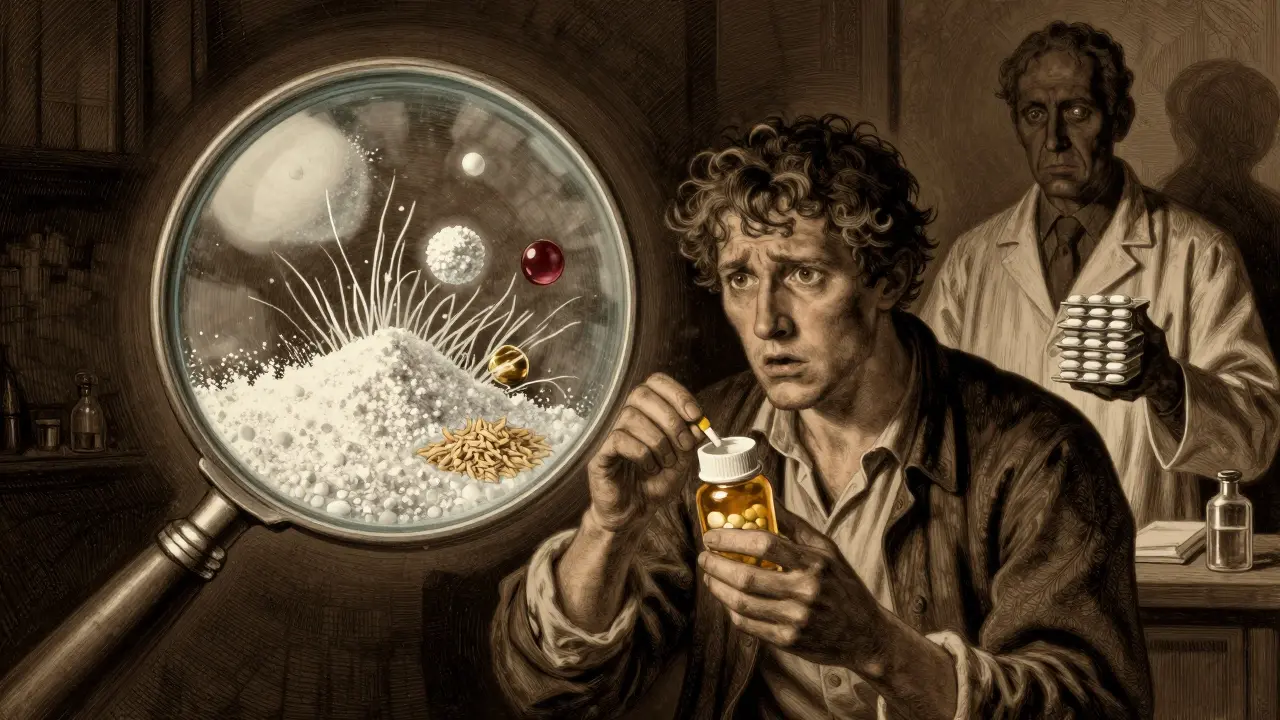
You take your generic blood pressure pill every morning. It’s cheaper. It’s approved by the FDA. And yet, every time you start a new bottle, you get a rash, your stomach churns, or your throat feels tight. You’re not imagining it. The problem isn’t the active drug-it’s what’s holding it together.
Most pills are 90% or more made of inactive ingredients. These are the fillers, binders, dyes, and preservatives that make the medicine easy to swallow, stable on the shelf, or taste less bitter. But for people with allergies or sensitivities, these harmless-seeming additives can trigger real, sometimes dangerous reactions.
A 2019 study from Brigham and Women’s Hospital and MIT looked at over 42,000 oral medications and found that 93% of them contained at least one ingredient that could cause an adverse reaction. That’s not a glitch. It’s the system.
What Are Inactive Ingredients-and Why Do They Matter?
Inactive ingredients, also called excipients, aren’t meant to treat anything. They’re the glue, the color, the sweetener, the shell. But they’re everywhere. About 45% of all prescription pills contain lactose. One in three has food dyes. Nearly 1 in 10 contains peanut oil, soy, gelatin, or sulfites.
These aren’t just in fancy brand-name drugs. They’re in the generic versions you’re told are "the same." But they’re not. The FDA only requires generics to match the active ingredient in strength and absorption. Nothing says the filler has to be identical.
Take Singulair. The 10mg tablet has lactose. The 4mg and 5mg versions? No lactose at all. Same drug. Same effect. Different fillers. Switch between them without knowing, and you could go from fine to hives.
And it’s not just allergies. People with irritable bowel syndrome (IBS) react to FODMAP sugars in meds. Those with Celiac disease can get sick from gluten in tablets-even if it’s not listed as an ingredient. One study found that only 15% of commonly prescribed drugs are verified gluten-free by certification programs.
Brand vs. Generic: The Hidden Difference
Doctors and pharmacists often say, "It’s the same drug." And technically, yes-the active ingredient is identical. But the rest? Totally different.
Brand-name companies design their formulations for consistency. Generics? They’re made by different manufacturers, often overseas, using whatever filler is cheapest or easiest to source. A pill made by Company A might use corn starch. Company B uses lactose. Company C uses a dye that triggers migraines in some people.
The Merck Manual warns that these differences can cause "unusual and sometimes severe allergic reactions." And you won’t know until it happens.
Pharmacists report that 87% of patients have come to them with concerns about reactions after switching from brand to generic. Most of those patients didn’t know to ask.
The Worst Offenders: Common Allergens in Pills
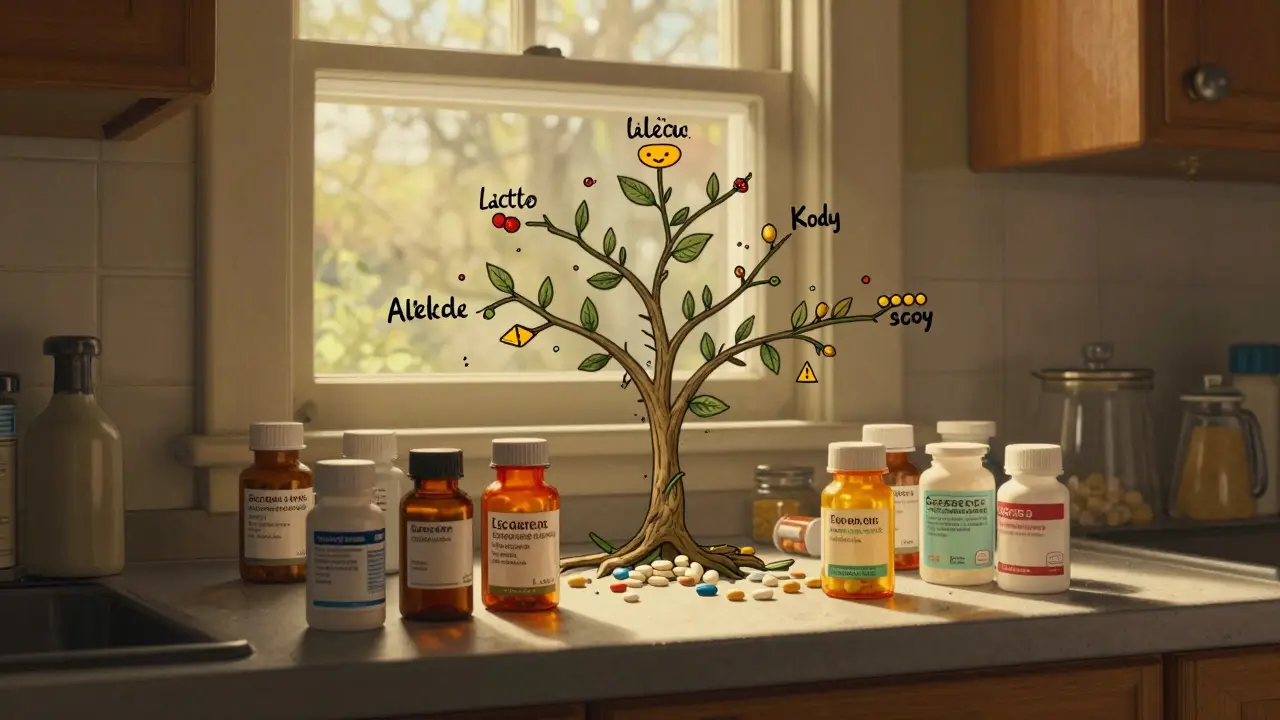
Some ingredients are far more dangerous than others. Here are the top culprits:
- Lactose: Found in over 20% of prescriptions and 6% of OTC meds. Dangerous for people with severe milk protein allergy, especially children.
- Gluten: Hidden in binders and coatings. Even tiny amounts can damage the intestines in people with Celiac disease.
- FD&C dyes: Yellow #5, Red #40, Blue #1-linked to hives, asthma, and hyperactivity. Used in kids’ medications and chewables.
- Sulfites: Sodium metabisulfite and potassium metabisulfite can cause life-threatening asthma attacks. These are required to be labeled-but only if they’re used as preservatives.
- Gelatin: Often from pork or beef. A problem for vegans, Muslims, Jews, and those with meat allergies.
- Peanut oil: Rare, but deadly. Required by law to be labeled. Still, some patients miss it.
- Soy: Used as a stabilizer. Can trigger reactions in people with soy allergy.
And here’s the kicker: You won’t find most of these on the bottle. Only peanut oil, sulfites, and a few others are legally required to be listed. Everything else? Hidden under vague terms like "other inactive ingredients."
What You Can Do: A Step-by-Step Plan
If you’ve had unexplained reactions to meds, here’s how to protect yourself:
- Keep a reaction log. Note the drug name, dose, when you started it, and what symptoms appeared. Was it a new generic? Did you switch brands? This helps connect the dots.
- Get tested. See an allergist. They can test for IgE-mediated allergies to milk, soy, peanuts, and eggs. For non-IgE reactions (like gluten or FODMAPs), work with a GI specialist.
- Build your personal allergen list. Write down every ingredient that causes you trouble. Include both food and medication triggers. You might be allergic to lactose in cheese-and in your blood pressure pill.
- Ask your pharmacist. Don’t just take the first generic. Ask: "Is there a version without lactose? Without dyes? Without gluten?" Pharmacists have access to detailed ingredient databases. 94% of them routinely help patients with these concerns.
- Check the official label. For prescription meds, the full ingredient list is in the patient information leaflet. For OTC drugs, it’s on the Drug Facts panel. Don’t skip it.
- Use the Inactive Ingredient Finder. This free mobile app, launched in 2023 by MIT researchers, lets you scan or search any U.S. medication and see its full excipient profile. It covers 98% of drugs on the market.
- Request brand-name when necessary. If you’ve had a reaction and the generic has the same active ingredient but a different filler, ask your doctor to write "Dispense as Written" or "Do Not Substitute." Insurance might push back-but it’s your health.
Why the System Is Broken-and What’s Changing
The FDA doesn’t require full labeling of excipients. Why? Because they’ve long considered them "inert." But science says otherwise.
The European Union has required full excipient disclosure since 2019. Result? A 37% drop in adverse reactions.
In the U.S., the FDA held a public workshop in 2021 and proposed new labeling rules in 2022. They want to force disclosure of eight high-risk ingredients: lactose, gluten, peanut oil, soy, sulfites, azo dyes, gelatin, and shellfish derivatives. But as of late 2023, the rule hasn’t been finalized.
Meanwhile, 68% of big pharma companies have improved their labeling voluntarily since the 2019 MIT study. But that’s not enough. Only 12% of generic medications currently offer allergen-free versions.
The American Medical Association wants mandatory labeling by 2026. If that happens, it’ll be the biggest shift in medication safety in decades.

What to Do Right Now
Don’t wait for the FDA to fix this. You’re your own best advocate.
If you’re on multiple medications-especially if you’re over 65-you could be taking five or more pills a day. That’s five chances for a bad filler to sneak in. One might have lactose. Another, dye. A third, gluten. Cumulative exposure can trigger reactions you never saw coming.
Start today. Pull out your pill bottles. Look up the ingredients. Talk to your pharmacist. Ask for alternatives. If you’re allergic to dairy, don’t assume your asthma inhaler is safe. If you’re gluten-sensitive, don’t trust the label unless you’ve checked the full excipient list.
Medicines are supposed to heal. They shouldn’t make you sick because of a dye or a sugar nobody told you about.
Frequently Asked Questions
Can I trust the "gluten-free" label on my generic medication?
Not always. While some manufacturers voluntarily label gluten-free meds, there’s no federal standard for medications like there is for food. The Celiac Disease Foundation verifies only about 15% of commonly prescribed drugs. Always check the full ingredient list with your pharmacist or use the Inactive Ingredient Finder app to confirm.
Why don’t pharmacists automatically warn me about inactive ingredients?
Most pharmacists don’t know unless you ask. Until recently, there was no easy way to access full excipient data. Now, 42% of pharmacies use electronic systems that flag allergens, but many still rely on outdated databases. Always speak up. Say: "I’m allergic to lactose-can you check if this generic has it?"
Are there any generic medications that are guaranteed allergen-free?
A few. Companies like Apotex, Teva, and Mylan now offer some generic versions without common allergens, especially for high-risk groups like children or those with Celiac disease. But they’re rare-only about 12% of generics have allergen-free options. You’ll need to ask specifically and check the manufacturer’s website or patient leaflet.
Can I switch back to the brand-name drug if the generic makes me sick?
Yes. If you have a documented reaction to a specific generic, your doctor can write "Dispense as Written" or "Do Not Substitute" on the prescription. Insurance may require prior authorization, but your health comes first. Many patients successfully switch back-especially if the brand version has a simpler, more predictable filler profile.
Is there a way to find out what’s in my medication without calling my pharmacist?
Yes. Use the free Inactive Ingredient Finder app, developed by MIT and launched in 2023. You can search by drug name, scan a barcode, or enter the NDC code from your pill bottle. It shows every ingredient, including dyes, sugars, and allergens, with warnings flagged. It’s the most reliable tool available right now.
Next Steps
If you’ve had a reaction to a medication, don’t ignore it. Document it. Talk to your allergist. Ask your pharmacist for alternatives. Use the Inactive Ingredient Finder app to check every new prescription. And if you’re on five or more meds, review them all at once-accumulation is the silent risk.
Medications are powerful. But their hidden ingredients? They’re often overlooked. You deserve to know what’s in your pill. You deserve to be safe. Start today. Your body will thank you.
Frank Declemij
January 30, 2026This is exactly why I started checking every pill label. I had unexplained hives for months until I realized my generic metoprolol had lactose. Switched to a lactose-free version and poof-symptoms gone. No drama, no guesswork. Just read the damn leaflet.
Pawan Kumar
January 30, 2026The FDA’s negligence here is not incompetence-it is collusion. The pharmaceutical-industrial complex has spent decades suppressing excipient transparency because profit depends on cheap, unregulated fillers. This is not a medical issue. It is a corporate cover-up. The EU moved on this in 2019. Why are we still allowing poison to be hidden under the word 'other'? This is systemic malpractice.
Keith Oliver
January 31, 2026Bro, I used to be one of those people who thought 'inactive' meant 'harmless.' Then I got a migraine from Red #40 in my kid's ADHD med. Turns out, it's in like 60% of chewables. I now scan every pill with the MIT app. It's wild how many drugs have soy, gluten, or dyes you'd never expect. The fact that pharmacists don't yell this from the rooftops is insane. You're not paranoid-you're just late to the party.
Robin Keith
January 31, 2026I’ve been thinking-what if the real tragedy here isn’t just the lactose or the dye, but the fact that we’ve been conditioned to believe that medicine is a neutral, scientific entity? That it’s pure, objective, untainted by commerce or convenience? But no. Medicine is a product. And products are optimized for cost, shelf life, and scalability-not for the fragile, unique biology of the human being who swallows it. We are not patients. We are variables in a supply chain. And the silence around excipients? That’s not oversight. That’s erasure. The body remembers. The body reacts. And we? We’re just supposed to take it… and thank them for the discount.
Sheryl Dhlamini
February 1, 2026I had a panic attack after starting a new generic thyroid med. No idea why. Turns out? It had gelatin capsules. I’m vegan. The pharmacist didn’t know either. I cried in the parking lot. Now I keep a printed list of my triggers and hand it to every pharmacist. It’s awkward but worth it. Don’t be shy. Your body isn’t asking for permission.
Andy Steenberge
February 3, 2026Great post. I’ve been working with patients on this for years. The key is not just knowing your allergens but knowing how to ask. Say: 'I need the full excipient list for this generic-can you pull up the manufacturer’s spec sheet?' Most pharmacies have it in their system now. Also, if you’re on multiple meds, cross-check for cumulative exposure. A little lactose here, a drop of soy there-add up fast. Use the MIT app. It’s free, accurate, and saves lives.
Laia Freeman
February 4, 2026OMG I JUST REALIZED MY AZT HAS YELLOW #5??? I’VE BEEN GETTING HEADACHES FOR 3 YEARS AND THOUGHT IT WAS STRESS?? I’M GOING TO THE PHARMACY RIGHT NOW. THANK YOU FOR THIS. I’M TELLING EVERYONE. I’M SO MAD BUT ALSO SO GRATEFUL. THIS IS LIFE CHANGING!!!
rajaneesh s rajan
February 5, 2026Lol. We spend billions on drugs that cure nothing but still can’t get a label that says 'contains milk sugar.' The system’s not broken-it’s working exactly as designed. Profit over safety. Convenience over truth. And we’re the ones who get to be the lab rats. At least in India, they at least put the ingredients in Hindi. Here? We gotta hack our way to basic safety. Welcome to the future.