

15 Dec 2025
- 8 Comments
When you wake up with a stuffy nose, itchy eyes, or a cough that won’t quit, it’s easy to blame the season. But for millions of Americans, the real culprit is hiding in plain sight-in your mattress, your couch, your carpet, even your air. Allergen avoidance isn’t about avoiding pollen on a windy day. It’s about transforming your home into a low-exposure zone. And when done right, it can cut symptoms in half, reduce your reliance on meds, and finally let you breathe easy.
Why Your Home Is the Problem (Not the Weather)
Most people think allergies are seasonal. But the truth? The biggest triggers live indoors. Dust mites, pet dander, mold, and cockroach particles are everywhere-and they’re not going anywhere unless you take action. In the U.S., 80% of allergy sufferers are allergic to house dust mites. That’s not a guess. That’s from clinical data. And if you’ve got a cat, you’re likely exposed to Fel d 1, a protein in cat saliva that sticks to everything. Dog dander? Same deal. These aren’t just annoyances. They’re immune triggers that keep your body in overdrive.Dust Mites: The Silent Saboteurs
Dust mites don’t bite. They don’t crawl on you. They live in your bedding, your pillows, your upholstered furniture-and they feed on dead skin flakes. Their waste is what triggers allergies. And they thrive in warm, humid environments. If your home’s humidity is above 50%, you’re basically running a mite resort. The fix? Start with your bed. That’s where you spend a third of your life. Invest in allergen-proof covers for your mattress, box spring, and pillows. These aren’t regular zippered cases. They’re made of tightly woven fabric that blocks mites and their waste from escaping. Look for ones labeled “barrier fabric” or “HEPA-grade.” They cost $30-$100 per set. Worth it. Next, wash all bedding weekly in water at least 130°F (54.4°C). Cold or warm water won’t kill mites. Hot water does. If you can’t wash everything in hot water, freeze stuffed animals or non-washable items for 24 hours-freezing kills mites too.Pet Dander: Can You Keep Your Pet?
If you’re allergic to pets, the easiest solution is to rehome them. But most people aren’t ready to do that. So here’s what actually works:- Keep pets out of the bedroom. This one change alone can reduce allergen levels by 30-55% in that room.
- Bathe cats weekly. It reduces airborne Fel d 1 by 41%. Yes, you read that right. Weekly baths make a measurable difference.
- Use a vacuum with a true HEPA filter. Regular vacuums blow allergens back into the air. HEPA vacuums trap them. Vacuum at least twice a week, focusing on carpets, rugs, and upholstery.
- Wipe down pets with a damp cloth once a week. It removes loose dander before it spreads.
Humidity Control: The Forgotten Key
Mold and dust mites both need moisture. Keep indoor humidity between 30% and 50%. That’s the sweet spot. Below 30%, your skin and airways dry out. Above 50%, you invite mold and mites. Buy a digital hygrometer-it costs less than $20. Place one in your bedroom and another in the basement or bathroom. If humidity is too high, run a dehumidifier. A good one costs under $150. Run it daily during humid months. In San Francisco, that’s mostly spring and fall. In humid climates, you might need to run it 12-18 hours a day. Fix leaks within 24 hours. Mold grows in 48 hours. If you see black spots on bathroom grout or a musty smell in the closet, it’s not just dirt. It’s mold. Clean it with a mixture of vinegar and water or a bleach solution. Don’t just spray-it needs scrubbing.HEPA Air Purifiers: Do They Work?
Yes. But only if you use them right. A true HEPA filter captures 99.97% of particles as small as 0.3 microns. That includes dust mites, pet dander, pollen, and mold spores. But not all air purifiers are created equal. Avoid “HEPA-type” or “HEPA-like” filters. They’re marketing buzzwords. Look for the word “true HEPA” on the box. Place one in your bedroom. It needs to run continuously. The unit should be sized for the room’s square footage. A small purifier won’t help in a large bedroom. Look for models that provide 4-6 air changes per hour. That means the entire volume of air in the room is filtered 4-6 times every hour. Don’t expect miracles from a $50 purifier from a big-box store. They’re often underpowered. Spend $200-$400 for a reliable unit. Brands like Coway, Blueair, and Winix have been tested in independent studies.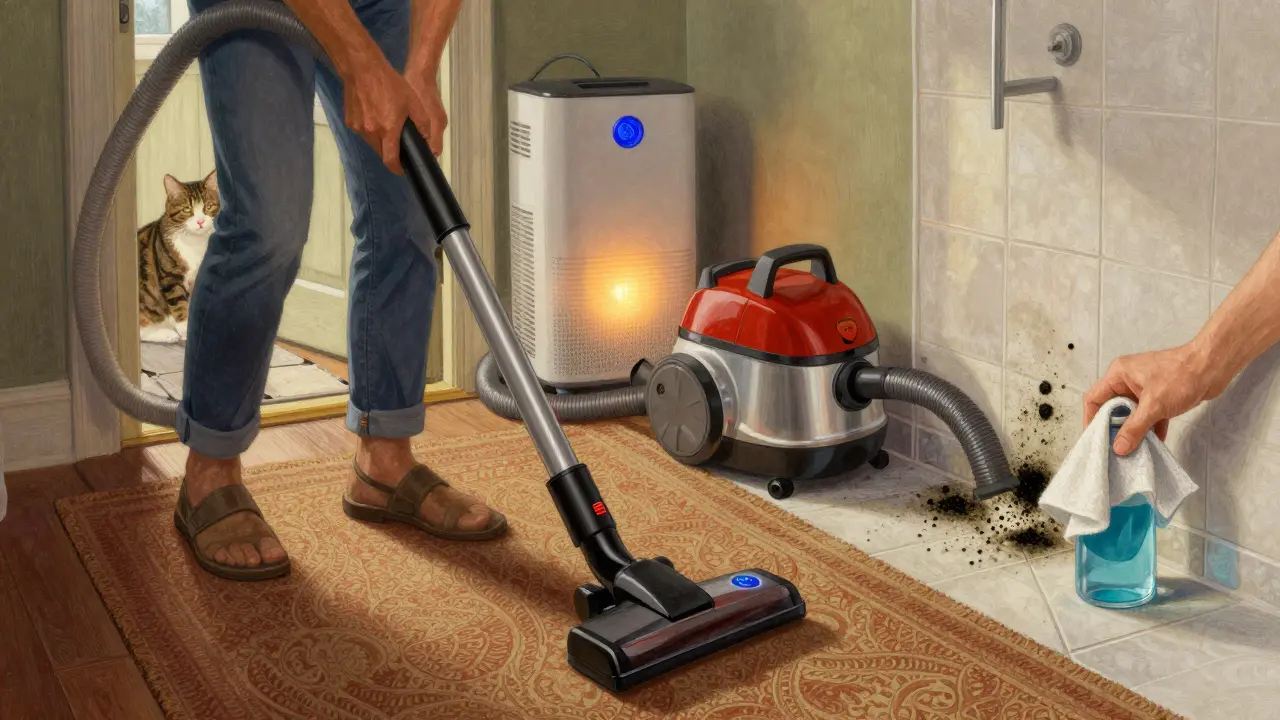
Cockroaches and Mold: Hidden Threats
Cockroach allergens are a major trigger in urban homes. Even if you don’t see them, their droppings and body parts are in kitchen cabinets, under sinks, and behind appliances. To control them:- Store all food in airtight containers-no exceptions.
- Empty the trash every night.
- Wipe down counters and floors daily.
- Use bait stations or boric acid, not sprays. Sprays scatter allergens. Baits kill the colony.
Why Single Fixes Don’t Work
Buying a HEPA filter alone? It helps, but not enough. Using allergen-proof bedding? Great-but if your humidity is 60%, mites come back in weeks. The science is clear: multi-intervention strategies are the only ones that deliver real symptom relief. A 2023 review of 15 clinical trials found that single interventions reduced allergen levels by 40-65%, but only 22% of patients saw symptom improvement. When people combined 3-5 strategies-bedding covers, HEPA filtration, humidity control, pet management-symptom improvement jumped to 83%. It’s not about doing one thing perfectly. It’s about doing several things consistently.Cost vs. Benefit: What’s Worth It?
You don’t need to bankrupt yourself. Here’s a realistic breakdown:- Low cost, high impact ($50-$150): Hygrometer, dehumidifier, allergen-proof pillow and mattress covers.
- Moderate cost ($200-$400): True HEPA air purifier for the bedroom, HEPA vacuum cleaner.
- Higher cost ($800-$2,500): Whole-house HEPA filtration system, professional pest control.
How to Start: A 3-Phase Plan
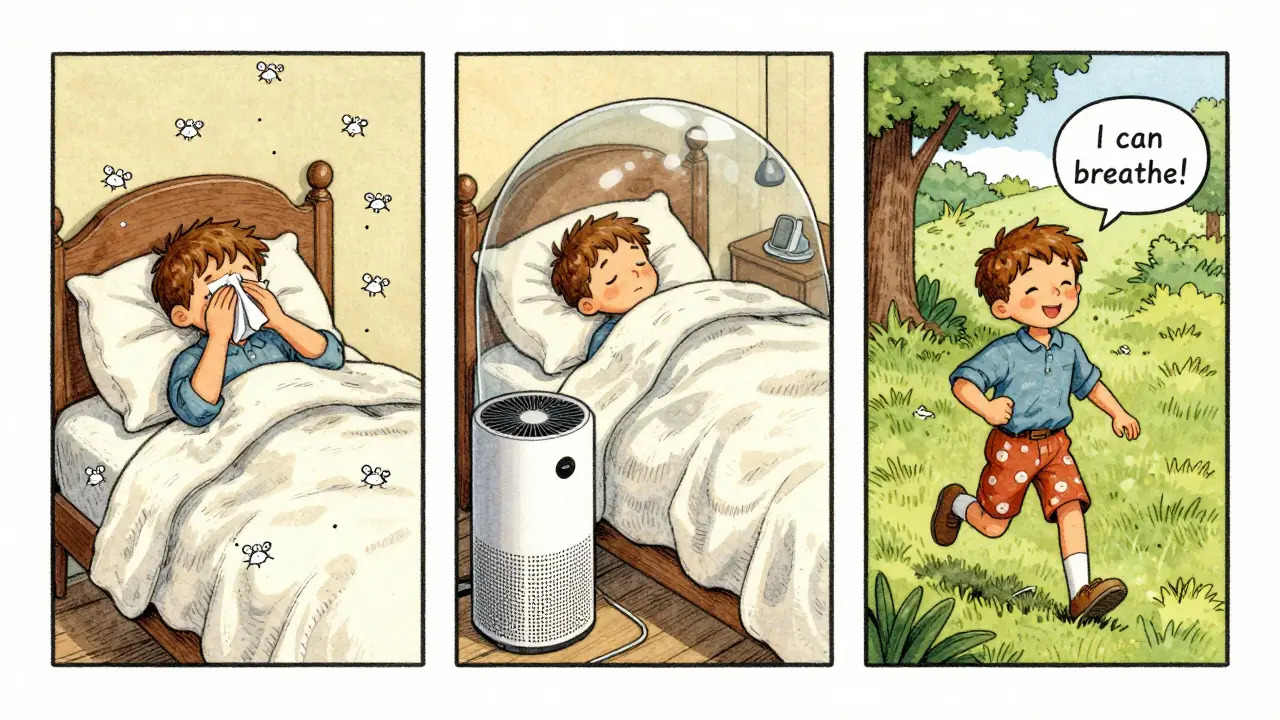
Don’t try to overhaul your home in a weekend. That’s how people quit. Phase 1: Weeks 1-2- Buy and install allergen-proof covers on your mattress and pillows.
- Place a HEPA air purifier in your bedroom and run it 24/7.
- Keep pets out of the bedroom.
- Buy a hygrometer. Monitor humidity daily.
- Start using a dehumidifier if humidity is above 50%.
- Wash all bedding weekly in hot water.
- Vacuum with a HEPA vacuum twice a week.
- Check for mold monthly-especially bathrooms and basements.
- Keep food sealed and trash emptied daily.
- Reassess every 3 months. If symptoms improve, keep going. If not, consider allergen testing.
What Doesn’t Work
Avoid these common traps:- “Hypoallergenic” pillows or bedding that aren’t sealed. They’re just marketing.
- Essential oil diffusers. They don’t reduce allergens-they can irritate airways.
- Indoor plants. They increase humidity and harbor mold.
- Using air fresheners to mask smells. Mold doesn’t smell like “clean linen.” It smells like dampness. That’s your warning sign.
When to Get Tested
If you’ve tried these steps for 3 months and still feel awful, get tested. Allergy testing (skin or blood) tells you exactly what you’re reacting to. You don’t need to control cockroach allergens if you’re only allergic to pollen. But if you’re allergic to dust mites, pet dander, and mold? That’s when you need the full plan.Who Benefits Most
This approach works best for people with:- Chronic nasal congestion or postnasal drip
- Asthma that flares at night
- Eye itching or redness that doesn’t improve with antihistamines
- Children with eczema or recurrent wheezing
Final Thought: It’s Not Perfect. But It’s Powerful
You won’t eliminate all allergens. You don’t need to. You just need to get them below the level that triggers your immune system. That’s the goal. And with consistent, smart steps, you can do it. The biggest barrier isn’t cost. It’s consistency. People start strong. Then they skip a week of laundry. They turn off the dehumidifier because it’s noisy. They let the pet back into the bedroom. And then they wonder why nothing changed. Allergen avoidance isn’t a one-time fix. It’s a lifestyle. But it’s the kind of lifestyle that lets you sleep better, breathe easier, and finally stop reaching for the antihistamines every morning.Can I just use a regular vacuum instead of a HEPA vacuum?
No. Regular vacuums blow fine allergen particles back into the air through their exhaust. HEPA vacuums trap those particles inside the filter. If you’re serious about reducing allergens, a HEPA vacuum is non-negotiable. Look for models certified by the Asthma and Allergy Foundation of America (AAFA).
Is it necessary to wash bedding every week?
Yes-if you’re allergic to dust mites. Dust mites live in bedding and reproduce quickly. Washing weekly in hot water (130°F or higher) kills them and removes their waste. Cold or lukewarm water won’t do it. If you can’t wash everything weekly, rotate sets: use one set while the other is being washed.
Do air purifiers help with pollen allergies?
Yes, but only indoors. Pollen comes in through open windows and on clothes. A HEPA air purifier won’t stop pollen from entering your home, but it will remove it from the air once it’s inside. Use it in your bedroom, especially during high-pollen seasons. Keep windows closed and use air conditioning instead.
Can I use a humidifier if I have allergies?
Only if your indoor humidity is below 30%. Otherwise, no. Humidifiers add moisture-and mold thrives in moisture. If you live in a dry climate and your skin or throat feels irritated, use a cool-mist humidifier sparingly and clean it daily. But if you’re in a humid area like San Francisco, you need a dehumidifier, not a humidifier.
What if I can’t afford all these changes?
Start with the cheapest, highest-impact steps: allergen-proof pillow and mattress covers ($30-$50), washing bedding weekly in hot water (no cost), and keeping pets out of the bedroom (no cost). These alone can cut allergen exposure by 50%. You don’t need to buy everything at once. Build over time. Even small steps make a difference.
How long until I notice improvement?
Most people notice reduced symptoms within 2-4 weeks. Nighttime breathing, morning congestion, and itchy eyes often improve first. Full benefits-like less reliance on medication-can take 6-8 weeks. Patience and consistency are key. Don’t give up after a week.
amanda s
December 16, 2025This article is basically a manifesto for overpriced home upgrades that only rich people can afford. I work two jobs and still can't afford a $400 air purifier-so what am I supposed to do, just keep coughing until I die? You act like allergens are some kind of moral failure. Newsflash: not everyone has a spare $2,000 to turn their house into a sterile lab.
And don't get me started on the ‘weekly hot water wash’ thing. My washing machine breaks every six months. I’m not buying a new one because some ‘expert’ thinks my dust mites are a personal affront to their hygiene standards.
Also, why are we pretending this is science and not a marketing scam? I’ve seen these ‘HEPA-grade’ mattress covers on Amazon for $12. They’re just plastic with zippers. You’re selling fear, not solutions.
Michael Whitaker
December 18, 2025While I appreciate the earnestness of the piece, I must respectfully underscore that the efficacy of environmental control measures is contingent upon a rigorous adherence to evidence-based protocols, many of which are not universally accessible due to socioeconomic constraints.
Furthermore, the assertion that HEPA filtration constitutes a non-negotiable intervention warrants nuanced qualification: while peer-reviewed literature supports its utility in controlled environments, real-world compliance rates are notoriously low, particularly among populations lacking temporal or financial bandwidth.
One must also consider the psychological toll of perpetual environmental surveillance-living in a state of hyper-vigilance regarding humidity levels, vacuuming schedules, and pet access-may exacerbate anxiety disorders, thereby negating the very physiological relief sought.
Thus, while the framework presented is theoretically sound, its practical implementation demands a structural reimagining of public health infrastructure, not merely individual consumerism.
Jigar shah
December 18, 2025Interesting read. I live in Mumbai, and humidity here is always above 70% year-round. I tried the allergen-proof covers, but they trap heat so badly that I sleep worse. Also, washing bedding at 130°F is impossible without industrial equipment here. We use sun-drying instead-it’s traditional, free, and surprisingly effective if done for 6+ hours.
Also, cats here are outdoor animals. They don’t sleep on beds. So pet dander is less of an issue. Maybe the advice needs to be localized? Not everything works the same in a tropical climate.
Kent Peterson
December 20, 2025You say ‘multi-intervention strategies’ work? That’s a lie. I did ALL of this. Covers. Purifier. Dehumidifier. HEPA vacuum. Weekly washes. Pets out of the bedroom. And guess what? Still sneezing. Still itchy. Still waking up with my throat glued shut. So you’re not just selling advice-you’re selling false hope. And that’s unethical. Also, who the hell has time to wipe down their cat every week? That’s not pet ownership-that’s slavery. And you’re telling people to do it? Pathetic.
Evelyn Vélez Mejía
December 22, 2025There is a profound irony in the modern allergy epidemic: we have engineered our environments into sterile, climate-controlled bunkers, yet our immune systems-starved of microbial diversity-have become hypersensitive specters of their former selves.
The very act of attempting to eradicate all allergens is, in a sense, a rebellion against evolution. We have forgotten that immunity is not forged in isolation, but in the messy, damp, dander-filled symphony of lived experience.
Perhaps the true solution lies not in purifying our homes, but in rewilding our children-letting them play in dirt, letting them kiss dogs, letting their lungs breathe the unfiltered air of a world that refuses to be sanitized.
And yet… I still sleep with a HEPA filter. Because even philosophers need to breathe at night.
Nishant Desae
December 22, 2025Hey, I just wanted to say this article really helped me. I’ve had asthma since I was a kid and always thought it was just ‘bad luck.’ But after reading this, I started with the mattress covers-only $40-and washed my sheets in hot water for the first time in years. I didn’t believe it would do anything, but after two weeks, I stopped waking up gasping. My wife even noticed I’m not coughing in my sleep anymore.
I didn’t get the purifier yet, but I’m saving up. And I’m keeping my dog out of the bedroom, which was hard-he’s my buddy-but he sleeps on the floor now and still cuddles me in the morning. It’s not perfect, but it’s better. Thank you for writing this. You made me feel like I’m not alone in this.
Philippa Skiadopoulou
December 23, 2025Effective allergen control requires consistent, targeted interventions. Bedding covers, humidity management and HEPA filtration are the core triad. Other measures are supplementary. Avoid overcomplication. Simplicity yields sustainability.
Pawan Chaudhary
December 24, 2025This is awesome! I just started phase one and already feel better. I used to think I was just ‘sick all the time’ but now I know it’s my bedroom. I got the covers, put the purifier on, and kept my dog out. He’s sad but I’m breathing! I’m gonna save up for the dehumidifier next. You’re right-it’s not about being perfect, it’s about being consistent. Thanks for the hope!