
22 Jan 2026
- 9 Comments
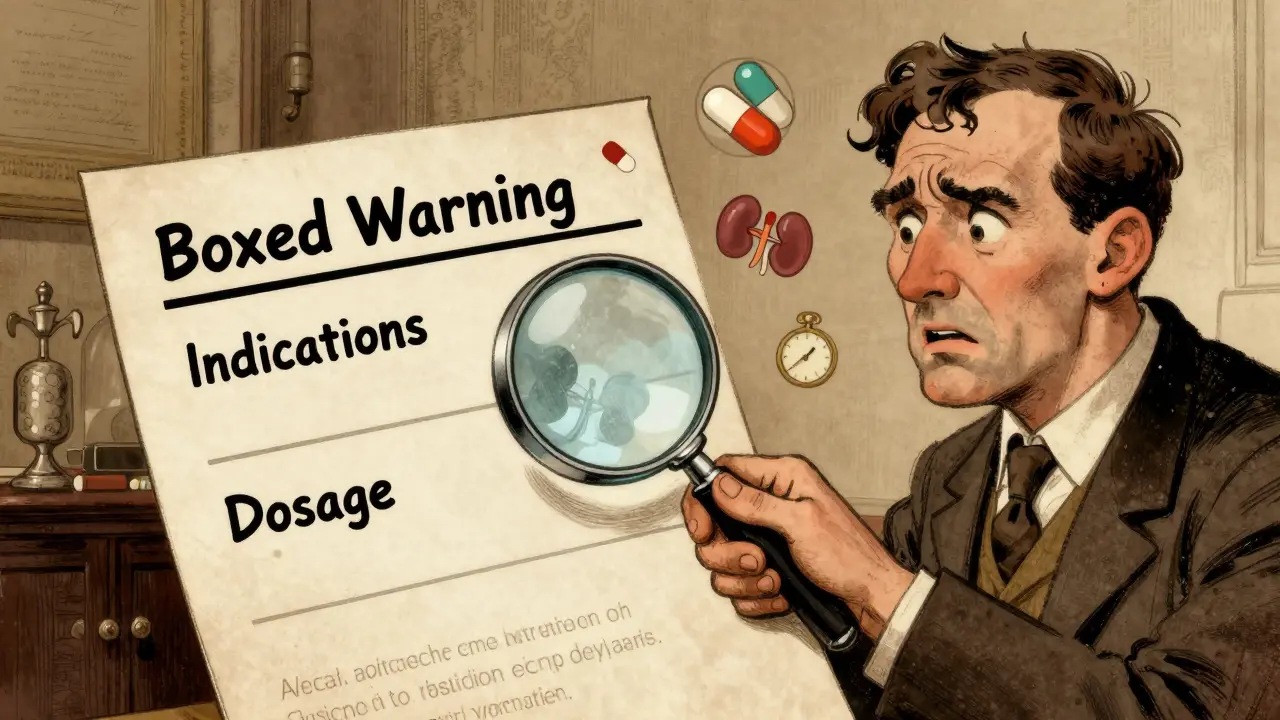
When you pick up a prescription, the small paper insert inside the box might look like a legal document written in invisible ink. But that label isn’t just fine print-it’s your roadmap to safe, effective medication use. The U.S. Food and Drug Administration (FDA) requires every prescription drug to come with a standardized label called the United States Prescribing Information (USPI). This isn’t optional. It’s the law. And if you’re a patient, caregiver, or even a healthcare provider, knowing how to read it can prevent serious mistakes.
Why FDA Drug Labels Matter
Every year, over 1.3 million medication errors happen in the U.S. Many of them stem from misreading or ignoring the label. A 2020 analysis from the NCBI Bookshelf found that more than half of these errors involved incorrect dosing, timing, or route of administration. The FDA created the current labeling system in 2006 to fix this. Before that, drug labels were messy, inconsistent, and often buried critical warnings in paragraphs. Now, everything is in a fixed structure. No more guessing where to look.The label isn’t meant for casual reading. It’s designed for healthcare professionals-but that doesn’t mean patients shouldn’t understand it. In fact, a 2024 study by the Inner Compass Initiative found that 27% of patients rely only on the short summary section, missing life-saving details. That’s dangerous.
The Three Parts of the FDA Drug Label
Every FDA-approved drug label has three main parts:- Highlights of Prescribing Information-a half-page summary of the most urgent info.
- Table of Contents-a numbered list of the 17 sections.
- Full Prescribing Information (FPI)-the complete, detailed version.
The Highlights section is the first thing you’ll see. It’s short. It’s bold. But here’s the catch: it’s incomplete. The FDA requires this section to include a disclaimer: "This is a summary of important information. Read the full prescribing information for complete details." Don’t skip the rest.
Section 1: Indications and Usage
This tells you exactly what the drug is approved to treat. It’s not just "for high blood pressure." It’s specific: "For the treatment of hypertension in adults, as monotherapy or in combination with other antihypertensive agents." It also includes the drug’s Established Pharmacologic Class (EPC), like "angiotensin II receptor blocker." This helps doctors understand how it works in the body.Pay attention to any restrictions. For example, some drugs are only approved for use after other treatments have failed. If your doctor prescribes it for something not listed here, that’s called "off-label" use. It’s legal-but you should ask why.
Section 2: Dosage and Administration
This is where most mistakes happen. The label tells you how much to take, how often, and how to take it-by mouth, injection, patch, etc. But it doesn’t stop there. It also includes:- Dose adjustments for kidney or liver problems
- Special instructions for elderly patients
- How to handle missed doses
- When to stop taking it
In March 2024, the FDA updated guidance for this section to make dose adjustments clearer-especially for people with reduced kidney function. If you have chronic kidney disease, this section could be the difference between safety and toxicity.
Section 3: Dosage Forms and Strengths
This lists every version of the drug available. For example: "Tablets: 10 mg, 25 mg, 50 mg; Extended-release capsules: 75 mg." It also includes the National Drug Code (NDC)-a 10-digit number that uniquely identifies the product, manufacturer, and packaging. You’ll see this on your pharmacy label too. If you’re switching brands or generics, check this number to make sure you’re getting the same formulation.Section 4: Contraindications
This section says: "Do NOT use this drug if..." These are absolute red flags. For example: "Contraindicated in patients with a known hypersensitivity to the drug or any of its components." Or: "Avoid in patients with severe hepatic impairment."Ignoring contraindications can lead to allergic reactions, organ failure, or death. If you’ve had a bad reaction to a similar drug in the past, this is where you check.
Section 5: Warnings and Precautions
This is where the real danger lives. It’s broken into two parts:- Boxed Warning-the most serious risk, printed in a thick black border at the top of the label. This is the FDA’s strongest safety alert. For example: "Boxed Warning: Increased risk of death in elderly patients with dementia-related psychosis."
- Other Warnings-like risk of liver damage, heart rhythm changes, or suicidal thoughts.
These aren’t "maybe" risks. They’re documented, real, and common enough to require a warning. If you see a Boxed Warning, talk to your doctor. Don’t assume it’s not relevant to you.
Section 6: Adverse Reactions
This section lists side effects, with data from clinical trials. It doesn’t say "you might get a headache." It says: "Headache occurred in 12% of patients taking this drug vs. 5% on placebo." That’s useful. It tells you how likely each side effect is.Look for the categories: "Very common" (≥1/10), "Common" (≥1/100 to <1/10), "Uncommon" (≥1/1,000 to <1/100). If you’re worried about a side effect, check its frequency. A 0.5% chance is rare. A 15% chance is common.
Section 7: Drug Interactions
This is critical if you take more than one medication. The label lists drugs that can dangerously interact with it. For example: "Concomitant use with strong CYP3A4 inhibitors increases risk of QT prolongation." Or: "Avoid grapefruit juice."Some interactions can be deadly. A 2023 study found that 1 in 5 hospitalizations for drug toxicity were due to unreported interactions. Always tell your doctor and pharmacist everything you take-including over-the-counter meds, vitamins, and herbal supplements.
Section 8: Use in Specific Populations
This section answers questions like:- Is it safe during pregnancy?
- Can I breastfeed while taking it?
- Is it approved for children?
- Do older adults need lower doses?
The FDA requires separate data for each group. For example, a drug might be safe for adults but not tested in kids under 12. Or it might be cleared for pregnancy Category B-but only if benefits outweigh risks. If you’re pregnant, nursing, or caring for an elderly parent, this section is non-negotiable.
Section 9: Drug Abuse and Dependence
For controlled substances like opioids, stimulants, or benzodiazepines, this section details addiction potential, withdrawal symptoms, and abuse patterns. It’s not just for addicts-it’s for everyone. Even a 2-week course of a strong painkiller can lead to dependence. The label tells you how.Section 10: Overdosage
What happens if you take too much? Symptoms. Treatment. What to do. This section saves lives. For example: "Symptoms include dizziness, vomiting, and respiratory depression. Treatment: supportive care, activated charcoal, naloxone if opioid overdose." Keep this section handy if you’re managing high-risk medications.Section 11: Description
This is the chemical breakdown: active ingredient, salt form, molecular weight. Most patients don’t need this-but if you’re allergic to a specific salt (like sulfates or tartrates), this is where you’ll find it.Section 12: Clinical Pharmacology
How does the drug work? How long does it last? How is it processed by the liver or kidneys? This section is technical, but useful. If you’re wondering why your doctor told you to take it at night, or why you can’t drink alcohol with it, this is where the answer hides.Section 13: Nonclinical Toxicology
Animal studies on cancer risk, genetic damage, and long-term effects. It sounds scary-but it’s required. If a drug caused tumors in rats at high doses, it’s here. That doesn’t mean it causes cancer in humans-but it’s something your doctor should know.
Section 14: Clinical Studies
This is the evidence. Who was studied? How many? What were the results? If you’re skeptical about a drug’s effectiveness, this section shows you the data. For example: "In a 12-week trial of 800 patients, 68% achieved target blood pressure vs. 41% on placebo."Section 15: References
The studies and papers the label is based on. If you want to dig deeper, this is your starting point.Section 16: How Supplied/Storage and Handling
This tells you how the drug comes-bottles, blister packs, syringes-and how to store it. Refrigerated? Keep away from light? Use within 30 days after opening? This section prevents wasted medicine and unsafe use.It also includes the NDC code again. If you’re switching pharmacies or ordering online, this number ensures you’re getting the exact same product.
Section 17: Patient Counseling Information
This is the only section written for patients. It gives healthcare providers exact phrases to use when explaining the drug. For example: "Take this medication with food to reduce stomach upset." Or: "Do not stop taking this medication suddenly-you may have withdrawal seizures."Surprisingly, only 38% of providers use this section in real conversations, according to a 2024 audit. That means you’re missing out on clear, standardized advice. Ask your pharmacist: "What does the FDA say I should know about this drug?" They’re required to use this language.
The Recent Major Changes Section
Since 2018, every label must include a section titled "Recent Major Changes." It lists every update made in the last six months. Did the dosage change? Was a new warning added? Did a drug interaction get upgraded to a Boxed Warning? This section tells you.On average, labels are updated every 14.3 months. If you’ve been taking the same drug for years, check this section every time you refill. A change you didn’t know about could be life-saving.
How to Use This Information
Here’s a simple three-step approach:- Start with the Boxed Warning and Highlights. What’s the biggest risk?
- Check Sections 1, 2, and 7. Is this right for me? Am I taking it correctly? Will it interact with my other meds?
- Read Section 17. What should I tell my family? What signs should I watch for?
If you’re a caregiver, print out the label and keep it with the meds. If you’re a patient, don’t be afraid to ask your pharmacist to walk you through it. Most will do it for free.
What’s Changing in 2025 and Beyond
The FDA is testing new digital labels with interactive features-like pop-up explanations for medical terms or links to video instructions. By 2027, over half of new drugs may include these enhancements. But for now, the paper label is still the law.One thing won’t change: the label is your best defense against medication errors. It’s detailed. It’s precise. And it’s updated regularly. Ignoring it isn’t convenience-it’s risk.
Can I trust the FDA drug label if my doctor says something different?
Always follow your doctor’s advice, but ask for clarification. Doctors sometimes prescribe off-label uses-medications approved for one condition but used for another. The label won’t reflect that. If your doctor prescribes something not listed in Section 1 (Indications), ask: "Is this an off-label use? What’s the evidence?" The label is the official standard-but doctors can use clinical judgment.
Why do generic drugs have the same label as brand-name drugs?
By law, generic drugs must have identical active ingredients, strength, dosage form, and labeling as the brand-name version. The FDA requires this to ensure safety and effectiveness. The only differences are in inactive ingredients (like fillers) and packaging. The label you see for a generic drug is the same as the brand, down to the Boxed Warning and dosage instructions.
What if the label says "not for use in children" but my child was prescribed it?
This is off-label use. It’s legal and sometimes necessary, especially for rare conditions or when no pediatric-approved drug exists. But it means the drug hasn’t been formally tested in children. Ask your doctor: "What data supports this use? Are there known risks for kids?" Always check Section 8 for any available pediatric data, even if it’s limited.
Are FDA labels updated in real time?
No, but they’re updated quickly. When new safety data emerges, manufacturers must report it to the FDA within 15 days. The agency then reviews it and requires a label update within 30 days. However, in 2023, nearly 28% of updates were delayed beyond that window. Always check the "Recent Major Changes" section on your label to see if it’s current.
Can I find FDA drug labels online?
Yes. The FDA’s website has a public database called Drugs@FDA where you can search for any approved drug and download its full prescribing information. Go to [email protected], type in the drug name, and look for the "Label" link under "Approved Drug Products." This is the official source-more reliable than pharmacy websites or third-party apps.
What to Do If You’re Confused
If the label feels overwhelming, you’re not alone. Even doctors admit it’s dense. Here’s what to do:- Ask your pharmacist for a 5-minute walkthrough.
- Print the label and highlight the sections that matter most to you.
- Use the "Patient Counseling Information" section (Section 17) as your cheat sheet.
- Keep a medication journal: write down what the label says, what your doctor said, and what side effects you notice.
The FDA didn’t make this label to confuse you. It was built to protect you. The only thing missing is your attention.
Gina Beard
January 22, 2026Most people treat prescriptions like magic pills. They don’t read the label because it’s boring. But that’s the exact moment you stop being a patient and become a statistic.
It’s not about fear. It’s about awareness.
You wouldn’t fly a plane without reading the manual. Why do it with your body?
Shelby Marcel
January 23, 2026wait so the box warning is like… the red flag emoji but in legal text? lol i always skip to the side effects part and go ‘oh cool i might get dizzy’ and just keep going
guess i’m a walking clinical trial
blackbelt security
January 25, 2026Knowing how to read this label isn’t optional. It’s your last line of defense.
Doctors are busy. Pharmacists are rushed. You’re the only one who has to live with the consequences.
Take five minutes. Save your life.
Patrick Gornik
January 26, 2026Let’s be real-the FDA’s labeling system is a masterpiece of bureaucratic theater.
They’ve turned pharmacology into a choose-your-own-adventure novel where the real plot twist is whether your kidney function is above 30 mL/min.
Meanwhile, the pharmaceutical industry pays lobbyists to bury the most damning data in Section 14.2b, buried under 17 sub-subheadings written in Latin-adjacent legalese.
It’s not transparency-it’s obfuscation with a side of compliance.
And don’t get me started on the NDC codes. That’s just a barcode designed to confuse anyone who doesn’t work in a warehouse in New Jersey.
So yes, read the label. But also ask: who benefits from you needing a PhD to understand your own medicine?
The system isn’t broken. It’s engineered to make you feel powerless so you don’t question the price tag.
And yet, here we are-reading it anyway, like gladiators reading the arena map before stepping in.
Brave? Maybe. Naive? Absolutely.
But at least we’re not the ones selling the swords.
Tommy Sandri
January 26, 2026The standardization of the United States Prescribing Information represents a significant advancement in patient safety and clinical communication.
While the complexity may appear daunting, the structured format enables consistent interpretation across diverse healthcare settings.
It is imperative that patient education initiatives evolve in tandem with these regulatory frameworks to ensure equitable understanding.
Health literacy remains a critical determinant of therapeutic outcomes, and this labeling system, when properly contextualized, can serve as a powerful tool in empowering informed decision-making.
Luke Davidson
January 27, 2026I used to skip all this stuff until my grandma ended up in the ER because she took her blood thinner with grapefruit juice-no one told her it was in the warnings.
Now I print out the full label for every new script and highlight the box warnings in yellow.
My mom thinks I’m crazy. But when you’ve seen someone almost die because of a missed sentence, you don’t take chances.
It’s not paranoia. It’s protection.
And yeah, it’s a pain. But so is a funeral.
So I read it. Every. Single. Time.
And I make sure my whole family knows how to find the contraindications too.
It’s not about being a nerd. It’s about being alive.
And if you’re still scrolling past this because it’s ‘too long’-just pause. Breathe. Open the insert.
You’ve got this.
Shanta Blank
January 29, 2026So let me get this straight-the FDA made a 17-section legal novel so we can survive our own prescriptions, but the drug companies still charge $2,000 for a 30-day supply of a pill that was invented in 1987?
And we’re supposed to be grateful they didn’t bury the ‘may cause sudden cardiac death’ part in the footnotes?
Oh, I’m so moved.
This isn’t safety. This is performance art for shareholders.
They give us a map… then charge us for the compass.
And we still thank them for the ‘transparency’.
Pathetic.
But hey, at least we know what’s killing us now.
Thanks, capitalism.
Kevin Waters
January 29, 2026Great breakdown. I’ve been teaching this to my patients for years.
Especially Section 2-dosing adjustments for kidney issues. So many people don’t realize their meds can turn toxic if their GFR drops.
And Section 4? Contraindications aren’t suggestions. They’re deal-breakers.
One guy took a beta-blocker even though it said ‘avoid in asthma’-ended up in ICU for 3 days.
Now I hand out a one-pager I made with the top 5 things to look for.
It’s not rocket science. Just common sense.
And if you’re a caregiver? Do this for the people you love.
You’re not just reading a label-you’re holding someone’s life in your hands.
Jamie Hooper
January 30, 2026bloody hell i just realised i’ve been taking my statin with grapefruit since 2020 and never checked the label
guess thats why i’ve been feeling like a zombie
time to go dig out that tiny paper thing i threw in the bin last week
rip my liver