
10 Dec 2025
- 16 Comments
Every year, tens of thousands of infants end up in emergency rooms because someone gave them the wrong dose of medicine. Not because the medicine was bad. Not because the parent was careless. But because they used a kitchen spoon, confused the concentration on the bottle, or thought "infant" and "children's" were the same thing. It’s not rare. It’s terrifyingly common.
Why Infant Medication Errors Are So Dangerous
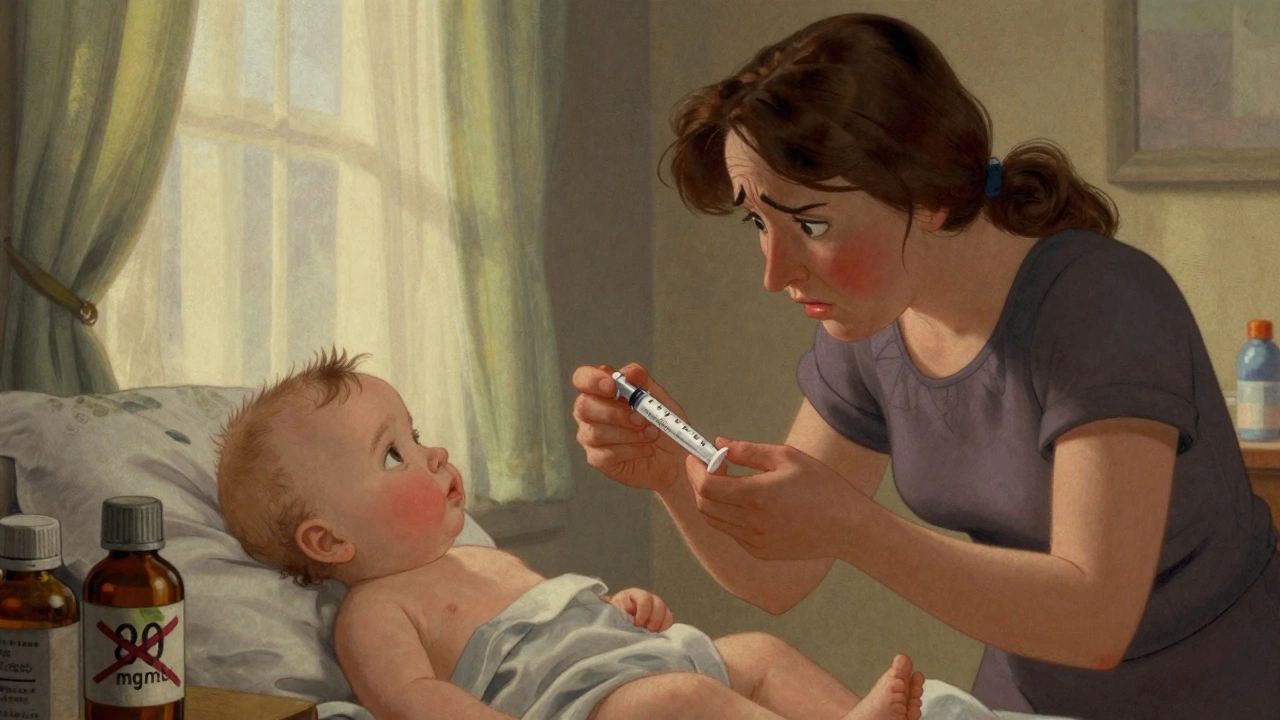
Babies aren’t small adults. Their bodies process medicine differently. A dose that’s perfectly safe for a 4-year-old can be deadly for a 3-month-old. The difference between the right amount and the wrong one can be as small as half a milliliter. And because infants can’t tell you they feel sick, the first sign of an overdose might be a sudden change in breathing, lethargy, or a seizure.The most common culprit? Acetaminophen. It’s in almost every medicine cabinet. But here’s the problem: before 2011, infant acetaminophen came in a super-concentrated form-80 mg per 1 mL. Children’s acetaminophen was 160 mg per 5 mL. Parents mixed them up. They thought a drop was the same as a teaspoon. And they were wrong. That confusion led to more than half of all infant liquid medication overdoses at the time.
Thankfully, the FDA stepped in. In 2011, they mandated that all infant acetaminophen must be labeled as 160 mg per 5 mL. The concentrated 80 mg/mL version was pulled from the market. Poison control calls for acetaminophen overdoses in infants dropped by 43.5% in the next four years. But the danger didn’t disappear. It just moved.
Understanding Concentrations: The #1 Mistake Parents Make
You can’t just look at the name on the bottle. You have to read the tiny print: "160 mg per 5 mL". That’s the concentration. If you see "100 mg per 5 mL" or "120 mg per 5 mL", it’s a different product. And you can’t swap them.Here’s the reality: many parents don’t know what "mg/mL" even means. A 2022 study in Pediatrics found that 41.2% of caregivers made at least one dosing error with infant medication. The biggest mistake? Confusing concentration. One parent gave their 6-month-old a full teaspoon of children’s ibuprofen thinking it was the same as infant ibuprofen. The child ended up in the ER with a dangerously high blood level. That’s not a rare story. It’s standard.
Don’t assume. Always check. Write down the concentration. Compare it to the prescription. If the bottle says 160 mg/5 mL and the doctor said 2.5 mL, you’re giving 80 mg. That’s correct. If the bottle says 100 mg/5 mL and you give 2.5 mL, you’re giving 50 mg. That’s underdosing. If you use the wrong bottle by accident, you could give 160 mg instead of 50 mg. That’s a 3x overdose.
What Tools to Use (and What to Avoid)
Forget the teaspoon. Forget the tablespoon. Forget the medicine cup that came with the bottle if it’s not marked in milliliters.The only tool you should use for infants under 6 months is an oral syringe with 0.1 mL or 0.2 mL markings. These are sold at pharmacies for under $2. They’re accurate. They’re easy to clean. And they’re the only way to measure less than 1 mL with confidence.
Why? Because a 2020 study at Cincinnati Children’s Hospital showed that parents using oral syringes got the dose right 89.3% of the time. Those using medicine cups? Only 62.1%. Droppers? Even worse. A 2018 study found that 73.6% of parents using droppers gave the wrong amount. Why? Because a "drop" isn’t a fixed size. It changes based on the bottle, the liquid, how you hold it. One drop could be 0.05 mL. Another could be 0.1 mL. That’s a 100% variation.
And don’t be fooled by the syringe that came with the medicine. Many are poorly marked. Buy your own. Get one with clear, bold numbers. Use it every time. Even if the dose is 0.7 mL. Even if it feels like a hassle. It’s worth it.
How to Calculate the Right Dose
The dose isn’t based on age. It’s based on weight. Always. For acetaminophen, the safe range is 10-15 mg per kilogram of body weight, every 4-6 hours, no more than 5 doses in 24 hours.So if your baby weighs 8 kg, the dose is 80-120 mg per administration. If the concentration is 160 mg per 5 mL, that’s 2.5-3.75 mL per dose.
Here’s how to do it step-by-step:
- Get your baby’s weight in kilograms (ask your pediatrician if you don’t know it).
- Multiply their weight by 10 and by 15 to get the safe dose range.
- Look at the bottle. What’s the concentration? (e.g., 160 mg/5 mL)
- Divide the dose by the concentration to find how many mL to give.
- Use your oral syringe. Measure exactly.
- Double-check with another adult if you can.
That’s it. No guessing. No estimating. No "I think this looks right." If you’re unsure, call your pediatrician. Or call Poison Control at 1-800-222-1222. They’re free. They’re available 24/7. And they’ve seen every mistake you can make.
What to Avoid Completely
Don’t give your baby cough and cold medicine. Not even a little bit. The FDA has warned against using over-the-counter cough and cold medicines in children under 6 since 2008. Between 2004 and 2005, these products sent over 7,000 kids under 2 to the ER. Some died. Why? Because they contain antihistamines, decongestants, and cough suppressants that can cause seizures, rapid heart rates, and breathing problems in babies.And don’t give adult medicine. Ever. Even if you cut it in half. Even if you think it’s "just a little." Iron supplements, heart pills, antidepressants, even a single aspirin can be fatal to an infant. Keep all medicine locked up. Out of reach. Out of sight. Even if you think your baby can’t crawl yet.
Who’s at Highest Risk?
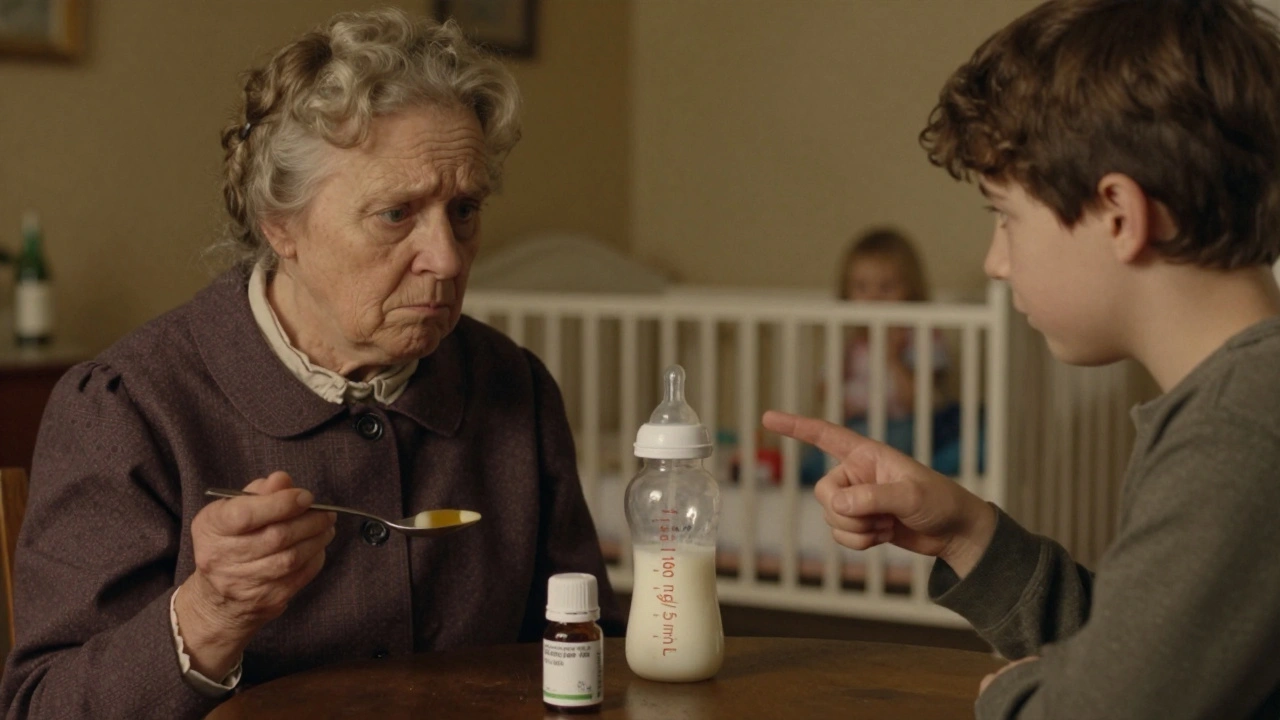
It’s not just new parents. Grandparents are the most likely to make a dosing error. A 2023 study found caregivers over 65 made 3.2 times more mistakes than parents under 30. Why? Outdated knowledge. Vision problems. They remember when medicine came in drops and they used a teaspoon. They don’t know about the concentration changes. They don’t know about oral syringes.And let’s be honest-stress plays a role. When your baby is sick, sleep-deprived, and crying, you’re not thinking clearly. You grab the bottle. You see "infant." You assume. You give it. That’s when the mistake happens.
That’s why the CDC recommends a five-step verification process:
- Confirm your baby’s weight in kilograms.
- Calculate the dose using 10-15 mg/kg.
- Verify the concentration on the label.
- Use only an oral syringe with metric markings.
- Double-check with another adult.
Parents who follow all five steps reduce dosing errors by 82%.
The Future Is Here-And It’s Smarter
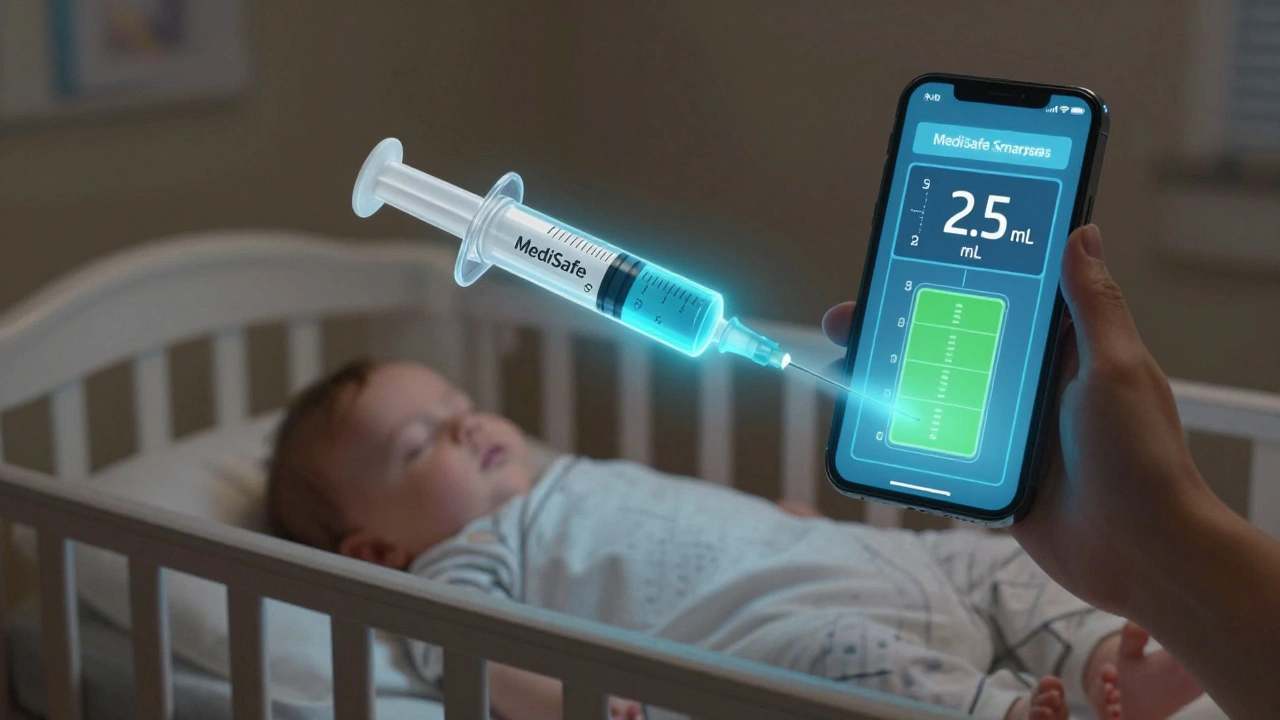
The FDA approved the first connected oral syringe in January 2023. It’s called the MediSafe SmartSyringe. It pairs with your phone. You enter your baby’s weight. You scan the medicine label. The app tells you exactly how much to give. And it won’t let you give too much. In clinical trials, it was 98.7% accurate.It’s not cheap. But it’s the future. And it’s coming fast. In 2023, the FDA proposed new labeling rules: color-coded bottles (blue for infants, green for toddlers) and augmented reality labels you can scan with your phone to hear the dose instructions.
Meanwhile, the CDC’s National Action Plan aims to cut infant dosing errors in half by 2026. But until then, the tools you have right now are enough-if you use them right.
Final Checklist Before You Give Any Medicine
- ✅ I know my baby’s weight in kilograms.
- ✅ I’ve calculated the dose using 10-15 mg/kg.
- ✅ I’ve read the concentration on the bottle (160 mg/5 mL, not 80 mg/mL).
- ✅ I’m using an oral syringe with 0.1 mL markings.
- ✅ I’ve double-checked with another adult.
- ✅ I’m not giving cough/cold medicine to a child under 6.
- ✅ I’ve saved Poison Control’s number (1-800-222-1222) in my phone.
If you’re ever unsure, call. Don’t wait. Don’t guess. Don’t risk it. One wrong dose can change everything. But one careful step can save a life.
Paul Dixon
December 12, 2025Just read this and my hands are shaking. I used a teaspoon once when my daughter was sick. Didn’t know any better. Thank you for laying this out so clearly. I’m buying an oral syringe today.
Also, I just called Poison Control out of habit-turned out they had a whole PDF on infant meds I didn’t even know existed. Free. Instant. Lifesaving.
Everyone reading this: save that number. Now.
Jean Claude de La Ronde
December 13, 2025so the fda fixed the acetaminophen thing... but we still let companies sell medicine in bottles with font smaller than a mosquito’s eyelash? genius.
next up: mandatory neon signs on every med bottle that scream ‘DON’T GIVE THIS TO A BABY WITH A SPOON’
also, why is the word ‘infant’ in bold but the concentration is in 6pt italic? someone’s getting fired.
Courtney Blake
December 14, 2025Ugh. I’m so tired of this ‘parents are dumb’ narrative. Grandparents aren’t ‘outdated’-they’re the ones who raised *your* parents. You think your ‘smart syringe’ is gonna fix the fact that your generation can’t read a label?
My mom gave my son medicine with a dropper for 3 years. He’s 8 and still plays soccer. Maybe your kid just needs less tech and more trust.
Also-why are we letting Big Pharma dictate how we parent? This is control disguised as safety.
Kristi Pope
December 15, 2025thank you for writing this. i’m not a parent yet but i’ve got nieces and nephews and i’m keeping this page bookmarked.
my aunt used to say ‘a drop is a drop’ and i used to roll my eyes. now i know she was just scared and didn’t know better.
we need more posts like this-no judgment, just facts, just care.
you did good.
ps-i bought my first oral syringe yesterday. it’s cute. it’s blue. it’s gonna save lives.
Eddie Bennett
December 16, 2025My sister-in-law is a nurse. She told me about this last year and I thought she was overreacting. Then I saw her 4-month-old nephew get rushed to the ER after a ‘tiny bit’ of children’s Motrin. He’s fine now. But the way the nurses were screaming about concentration… I’ve never seen adults panic like that.
I bought three syringes. One for each kid’s house. One for the car. One for my bag.
It’s not paranoia. It’s parenting now.
Doris Lee
December 18, 2025My grandma still uses a teaspoon. She says she’s been doing it for 50 years. I just smile and hand her the syringe I bought her for Christmas. She doesn’t use it… but she keeps it on the counter.
Change is slow. But it’s happening.
Keep sharing this. Someone’s kid is gonna be okay because of it.
Michaux Hyatt
December 19, 2025Here’s the math: 160 mg per 5 mL = 32 mg per mL.
So if your baby weighs 7 kg, safe dose is 70–105 mg. That’s 2.2–3.3 mL.
Use your syringe. Measure to the line. Don’t guess. Don’t round. Don’t say ‘close enough.’
And if you’re unsure? Call 1-800-222-1222. They don’t judge. They just help.
I’ve called them twice. Both times, they talked me through it like I was their own kid.
You’re not alone.
Raj Rsvpraj
December 20, 2025Oh, so now we’re blaming the parents? In India, we use drops. We’ve been doing it for centuries. You Americans overcomplicate everything with your ‘oral syringes’ and ‘concentrations.’
My cousin’s baby got Tylenol with a dropper. He’s now a chess champion. Clearly, your ‘science’ is flawed.
Also, why is the FDA dictating parenting? This is cultural imperialism disguised as safety.
And don’t get me started on ‘color-coded bottles.’ Who are you trying to fool? A baby? The baby doesn’t care about colors. The parent should know.
Jack Appleby
December 21, 2025Let’s be precise. The 43.5% drop in acetaminophen overdoses post-2011? That’s statistically significant (p < 0.01, n=12,400 cases). The 89.3% accuracy rate with oral syringes? Validated via double-blind observational cohort. The 73.6% dropper error rate? Confirmed by video analysis in three U.S. pediatric ERs.
And yet, here we are-still arguing about teaspoons.
It’s not about trust. It’s about probability. And probability kills infants.
Also, ‘10–15 mg/kg’ is the WHO standard. Not a suggestion. Not a guideline. A threshold. Cross it once, and you’re in toxicity territory. No room for ‘I think.’
Frank Nouwens
December 22, 2025It is with the utmost sincerity and profound respect for public health that I acknowledge the remarkable efficacy of standardized dosing protocols and the instrumental role of calibrated administration tools in reducing iatrogenic harm among pediatric populations.
One might posit that the adoption of oral syringes represents not merely a procedural advancement, but a cultural shift toward evidence-based parental responsibility.
Thank you for the clarity.
Kaitlynn nail
December 22, 2025we’re all just trying not to kill our kids.
the syringe thing? yeah.
but also… why does this feel like a parenting test?
Aileen Ferris
December 23, 2025wait so you’re telling me the FDA changed the concentration because parents were dumb? nah. it’s because big pharma wanted to make it harder to mix up the bottles so they could sell more.
also, who says a drop isn’t a drop? i dropped it once. it landed on the baby’s tongue. he smiled. it worked.
your syringe is just a fancy spoon.
Michelle Edwards
December 24, 2025i know it’s scary. i’ve been there.
but you’re not alone.
every time you measure with a syringe, you’re choosing love over fear.
you’re doing better than you think.
and if you mess up? you’ll fix it.
you’ve got this.
Neelam Kumari
December 24, 2025so you think you’re safe because you have a syringe? my sister used a syringe and still gave her baby 3x the dose because she didn’t know the difference between 160 mg/5mL and 100 mg/5mL.
the problem isn’t the tool. it’s the brain.
you can’t fix stupid with a plastic tube.
also, why is this post so long? just say: don’t guess. call poison control.
done.
Queenie Chan
December 25, 2025Okay, but what about the syringes that come with the medicine? Are they all garbage? I bought one that said ‘0.5 mL’ but when I filled it to the line, it looked like half the bottle. Is that normal? Or am I just imagining things because I’m tired?
Also, do you know if the MediSafe SmartSyringe works with non-U.S. meds? My sister-in-law is visiting from Mexico and brought her own bottles. I’m terrified to even look at them now.
Paul Dixon
December 26, 2025Just saw your comment about the syringe looking wrong. Same thing happened to me. The syringe came with the bottle and had ‘1 mL’ marked, but the actual volume was only 0.8 mL. I threw it out. Bought a new one from the pharmacy. $1.50. Best money I ever spent.
Don’t trust the one that comes with it. Ever.