

22 Mar 2026
- 8 Comments
When your neck isn't just sore - when your hands feel clumsy, your balance starts to slip, or you can't button your shirt like you used to - it might not be a pinched nerve. It could be something more serious: cervical myelopathy. This isn't just neck pain. It's your spinal cord being squeezed in your neck, and if left alone, it can lead to permanent damage. The most common cause? Cervical spinal stenosis - the narrowing of the spinal canal in your neck. Understanding the symptoms and knowing when surgery is truly necessary can make all the difference.
What Exactly Is Cervical Myelopathy?
Cervical myelopathy isn't a single disease. It's a condition that happens when the spinal cord in your neck gets compressed. Think of it like a garden hose being stepped on. The water (nerve signals) can't flow properly. In your body, that means messages from your brain to your arms and legs get scrambled. The most frequent cause is cervical spondylotic myelopathy (CSM), which makes up about 75% of all cases. It's caused by wear and tear over time - aging discs bulging, bones growing spurs, ligaments thickening. It's not rare. About 9% of people over 70 have it. And while you might not feel pain, the damage is still happening.
Here's the key point: spinal stenosis means narrowing. Myelopathy means the cord is injured. You can have stenosis without myelopathy - many people over 40 have narrowed canals but no symptoms. But once you start losing function, that's myelopathy. And it's progressive. It doesn't fix itself.
Early Warning Signs You Can't Ignore
People often dismiss early symptoms as just getting older. But these signs are red flags:
- Your hands feel numb or tingly, especially when typing or holding a phone.
- You drop things more often - keys, glasses, your coffee cup.
- Your handwriting gets messy or shaky.
- Walking feels off. You feel unsteady, like you're walking on cotton.
- You have trouble going up or down stairs.
- Your knees or ankles feel unusually stiff or reflexive - doctors call this hyperreflexia.
These aren't random quirks. They're the body's way of saying the spinal cord is under pressure. About 72% of patients report hand clumsiness as their first symptom. Nearly 70% notice balance problems. And if you're over 55 and experiencing any of this, don't wait. A study of 1,245 patients showed that 41% saw three or more doctors before getting the right diagnosis - and the average delay was over a year. That delay matters.
When Symptoms Get Worse: The Red Zones
If early signs are ignored, the condition can escalate. Advanced symptoms include:
- Loss of fine motor control - you can't turn a key or open a jar.
- Weakness in arms or legs that makes lifting objects hard.
- Urinary urgency - feeling like you need to go constantly, even if your bladder isn't full.
- In rare cases, loss of bladder or bowel control.
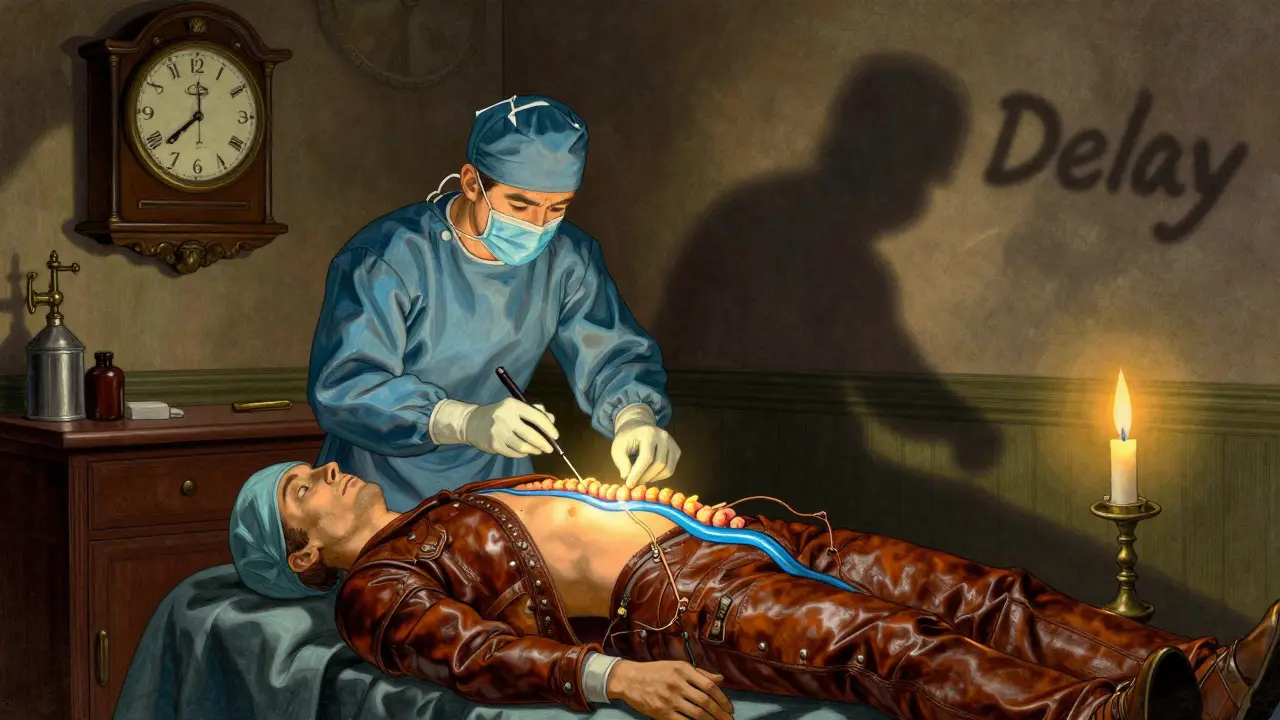
These aren't just inconvenient. They're signs the spinal cord is being damaged. Once nerve cells die from prolonged compression, they don't come back. That's why timing is everything. Research shows patients who wait more than 12 months after symptoms start have 37% less chance of regaining function after surgery than those treated within six months. Every month of delay costs you about 3% of your recovery potential.

How Doctors Diagnose It - Beyond the X-Ray
An X-ray won't show if your spinal cord is being squished. That's why MRI is the gold standard. It can see the actual cord and detect changes like T2-weighted hyperintensity - a bright spot on the scan that means the cord is injured. MRI is 97% accurate at spotting compression.
Doctors also use the Japanese Orthopaedic Association (JOA) score - a simple test that checks movement, sensation, and bladder control on a 17-point scale. A score below 14 usually confirms myelopathy. Other tests like EMG (to check nerve function) and SSEPs (to measure how fast signals travel) help rule out other causes like peripheral neuropathy.
And here's a crucial detail: not all stenosis needs surgery. Up to 21% of people over 40 have narrowing on MRI but no symptoms. So diagnosis isn't just about the scan. It's about matching the scan to your symptoms. If you have numbness, weakness, and gait problems - and the MRI shows cord compression - that's myelopathy.
Can You Avoid Surgery?
For very mild cases - JOA score of 12 to 14 - doctors might suggest trying physical therapy, activity changes, or NSAIDs. But don't get your hopes up. Only 28% of these patients improve over two years. Nearly two-thirds get worse. That's why experts don't recommend waiting. The North American Spine Society and the American Academy of Orthopaedic Surgeons both give strong recommendations for surgery when symptoms are moderate to severe (JOA score under 12). Why? Because without surgery, 20-60% of patients will get significantly worse over a few years. Only 10-15% improve on their own.
Surgery Options: What Works and What Doesn't
If surgery is needed, there are several approaches - and the right one depends on how many levels are affected and your spine's alignment.
Anterior Approaches (From the Front)
ACDF (Anterior Cervical Discectomy and Fusion): This is the most common surgery for one or two levels. The surgeon removes the damaged disc and bone spurs, then fuses the vertebrae with a bone graft and plate. Success rate? Around 85-90% of patients see neurological improvement. But there's a catch: 5-7% develop problems in adjacent segments within 10 years.
Cervical Disc Arthroplasty (Artificial Disc): This replaces the damaged disc with a metal or plastic implant that lets your neck move. Approved for single and now multilevel use since March 2023, it preserves motion and may reduce future problems. A 2023 study showed 81% success in keeping motion at 24 months - better than fusion.
Posterior Approaches (From the Back)
Laminectomy with Fusion: Removes the back part of the vertebrae to relieve pressure. Often used for multi-level disease. It's effective - 85% improve - but can cause more neck pain afterward.
Laminoplasty: Instead of removing bone, the surgeon opens the back of the vertebrae like a door. It's great for multiple levels and preserves motion. Studies show 82% success with less post-op neck pain than fusion. But recovery can be slower.
Minimally Invasive Laminoplasty: Developed in 2021, this technique cuts blood loss by 65% and shortens hospital stays by nearly two days. It's becoming more common in top centers.
What to Expect After Surgery
Most patients go home in 1-3 days. Recovery takes 3-6 months. Physical therapy is critical - 85% of patients need 8-12 weeks of rehab focused on balance, strength, and neck stability. You'll likely need to wear a neck brace for a few weeks. Some people have trouble swallowing for a few months after anterior surgery - that's normal and usually fades. About 35% of ACDF patients still feel some neck pain at six months. And 18% of those who had posterior surgery develop chronic axial pain - known as post-laminectomy syndrome.
But here's the good news: 82% of surgical patients report better hand function within a year. The key is timing. Those treated within six months of symptoms are 2.7 times more likely to have an “excellent” outcome on the JOA scale than those who waited.
What You Can Do Right Now
If you're experiencing symptoms:
- See a spine specialist - not just a general practitioner - within 2-4 weeks of noticing neurological changes.
- Get an MRI. Don't delay. Every week matters.
- Stop smoking. It cuts fusion success rates in half.
- If you're diabetic, get your HbA1c under 7.0 to reduce infection risk.
- Start gentle neck and core exercises. Strengthening helps stabilize your spine.
And if you're told your condition is "just aging" - get a second opinion. Many patients waited years before being correctly diagnosed. You don't have to.
The Future Is Personalized
Researchers are now looking beyond one-size-fits-all treatment. Genetic markers like COL9A2 polymorphisms are being studied to predict how fast degeneration happens. New neuroprotective drugs like riluzole are being tested alongside surgery - early results show 12% better recovery. Robotic-assisted surgery is on the horizon and could cut revision rates by nearly half. But for now, the best tool is still early recognition and timely intervention.
Don't wait for paralysis. Don't hope it gets better. If your hands are losing dexterity, your balance is failing, or you're struggling with everyday tasks - your spinal cord is telling you something. Listen. Act. Get the right diagnosis. And if surgery is needed - do it before the damage becomes permanent.
Can cervical myelopathy go away on its own?
No. Cervical myelopathy is a progressive condition caused by spinal cord compression. While symptoms may seem to stabilize for a while, the underlying damage continues. Without treatment, 20-60% of patients will experience worsening neurological function over 2-5 years. Only 10-15% show any spontaneous improvement. Waiting rarely helps - it usually makes things worse.
Is surgery the only option for cervical myelopathy?
Not always. For very mild cases - with a JOA score of 12-14 and no progression - doctors may try physical therapy, activity changes, or anti-inflammatory meds. But studies show only 28% of these patients improve over two years, while 63% get worse. For moderate to severe cases (JOA score under 12), surgery is the only proven way to stop progression and restore function. Guidelines from the American Academy of Orthopaedic Surgeons strongly recommend surgery in these cases.
How do I know if I need surgery?
You need surgery if you have both neurological symptoms (like hand clumsiness, gait instability, or weakness) and MRI evidence of spinal cord compression. The JOA scoring system helps doctors measure severity - a score below 14 indicates myelopathy. If your symptoms are getting worse, or if your score is under 12, surgery is strongly advised. Delaying increases the risk of permanent damage. Experts say waiting more than 12 months cuts recovery chances by 37%.
What’s the difference between cervical stenosis and cervical myelopathy?
Cervical stenosis means the spinal canal in your neck is narrowed - it’s an anatomical finding. Cervical myelopathy means that narrowing is actually damaging the spinal cord, causing neurological symptoms like numbness, weakness, or balance problems. You can have stenosis without myelopathy (many people do). But if you have symptoms, you have myelopathy. The distinction matters because only myelopathy requires urgent treatment.
How long does recovery take after cervical myelopathy surgery?
Most patients leave the hospital in 1-3 days. Full recovery takes 3 to 6 months. You’ll need physical therapy for 8-12 weeks to rebuild strength and balance. Hand function often improves within 3-6 months. Gait and coordination may take longer - some people still need assistive devices. The best outcomes happen in patients who had surgery within six months of symptom onset. Recovery slows the longer you wait.
Are there risks to cervical myelopathy surgery?
Yes. Major complications occur in 4-6% of cases, including difficulty swallowing (dysphagia), C5 nerve palsy (weakness in the shoulder or bicep), and - rarely - worsening neurological function. Anterior surgery (ACDF) has a 5-7% risk of adjacent segment disease within 10 years. Posterior surgery can lead to chronic neck pain in 18% of patients. But for those with moderate to severe myelopathy, the risk of doing nothing is far greater: permanent disability. The decision should be based on symptom severity, not fear of surgery.
What happens if I delay surgery?
Every month of delay reduces your recovery potential by about 3%. After 12 months, patients have 37% less chance of regaining function than those treated within six months. Nerve damage from prolonged compression becomes permanent. Once muscle weakness turns into muscle atrophy or reflexes disappear, those changes are often irreversible. Delaying surgery doesn’t make it safer - it makes recovery harder.
Early diagnosis and timely intervention are the only ways to prevent lifelong disability from cervical myelopathy. If you're experiencing changes in your hands, balance, or walking - don't wait. Get evaluated. Your future self will thank you.
Alex Arcilla
March 23, 2026I had this happen to my uncle. He thought it was just carpal tunnel for 2 years. Then one day he dropped his coffee cup, couldn't button his shirt, and almost fell down the stairs. MRI showed his spinal cord was squished like a soda can. Surgery saved him. Now he walks with a cane but can hold his grandkids. Don't wait. Seriously.
Zola Parker
March 23, 2026So... you're saying if I can't open a pickle jar anymore, I need spinal surgery? 🤔 I mean, I'm 48. Maybe my hands are just... done. Like my knees. And my will to live. 😌
florence matthews
March 25, 2026I really appreciate how clear this is. My mom had this last year and we were so scared. The fact that early signs like dropping things or clumsy hands are red flags? That's the kind of info that saves people. I wish more doctors talked like this. Thank you for sharing. ❤️
Kenneth Jones
March 26, 2026If you're over 55 and your hands are slow, get an MRI. Not a second opinion. Not a chiropractor. Not yoga. MRI. Now. This isn't a suggestion. It's a medical emergency. Stop wasting time.
Mihir Patel
March 27, 2026OMG I JUST REALIZED I’VE BEEN DROPPING MY PHONE FOR 6 MONTHS 😱 I THOUGHT IT WAS BECAUSE MY HANDS ARE SWEATY BUT NOW I THINK… IS THIS IT??? I’M GOING TO THE HOSPITAL TOMORROW. MY WIFE IS SCARED BUT I’M READY. 🙏 #CervicalMyelopathy #NotJustAging
Rachele Tycksen
March 28, 2026i read this and was like… wait i’ve been dropping my keys for like 3 years?? and my handwriting is trash now?? i think i might have this… but like… do i really need surgery?? i’m lazy.
Grace Kusta Nasralla
March 29, 2026It’s sad. We’re taught to ignore our bodies until they break. Then we’re told to cut into them. What if the real problem is that we live in a world that doesn’t let us rest? That we’re not meant to be hunched over screens for decades? I don’t know. I just feel… heavy.
Aaron Sims
March 31, 2026So let me get this straight… you’re telling me the medical industry is pushing surgery because they profit from it? That the '75% of cases are from wear and tear' is just a cover for Big Pharma and spine implant companies? And that the '28% improve with PT' statistic is cherry-picked? What about the 18% who develop chronic pain from posterior surgery? Who’s funding this 'research'? I’m not buying it. I’m getting a second MRI. And a lawyer.